What makes a weed ashtray different from a regular one
Most ashtrays sold in home goods stores are designed for cigarettes. They have shallow bowls, narrow rest notches, and no real thought given to what a joint actually needs. A joint burns hotter, drops ash more heavily, and often needs to rest at an angle that a cigarette notch doesn't accommodate. A dedicated weed ashtray tends to handle these things better, though the category varies widely in quality and design.
The market has also added some formats that have no real cigarette equivalent -- debowler ashtrays being the main one. If you're shopping for a smoking ashtray and haven't looked at the available options in a while, there's more variety than you might expect. Let's go through each material type honestly.
Silicone ashtrays
Silicone is the most practical material for most regular smokers, and I say that as someone who spent years defaulting to ceramic. The functional argument is hard to argue with: you can fold it, drop it, throw it in a bag, run it under the tap, and it still looks and works the same.
Heat resistance on quality silicone is well above what a joint or pipe will produce. A resting coal won't damage it. A dropped bowl piece won't crack it the way it would glass or ceramic. If you knock it off the table, it bounces rather than shatters. That combination of properties makes silicone the right call for outdoor use, travel, or any setting where you don't want to worry about the piece.
The tradeoff is aesthetics. Silicone reads as functional, not decorative. If you care about what your setup looks like on a shelf or a coffee table, silicone is not going to impress anyone. The colors are fine, but they don't have the visual weight that ceramic or glass does.
Cleaning is genuinely easy. Most silicone ashtrays go straight in the dishwasher, or you can run them under hot water with dish soap and they come out clean in 30 seconds. Resin and tar don't bond strongly to silicone the way they do to glass or ceramic.
Ceramic ashtrays
Ceramic is what most people picture when they think of an ashtray. The material has real advantages: it looks good, accepts custom printing and glazes well, and has enough thermal mass that it stays cool to the touch even when there's an active joint resting in it.
Cleaning ceramic is straightforward but requires a bit more attention than silicone. Resin can bond to unglazed or roughly textured ceramic surfaces and build up over time. Fully glazed pieces are much easier to clean. A soak in warm water with dish soap, followed by a scrub with a soft brush, handles most buildup. For heavier resin staining, isopropyl alcohol works well without damaging the glaze.
The main practical downside is fragility. Drop a ceramic ashtray on a hard floor and you'll likely break it. This is less of a concern if it lives permanently on your coffee table and never gets moved, but if you carry it around or use it outdoors, you're going to have a short relationship with it.
For dispensaries or anyone thinking about custom branding, ceramic is one of the best surfaces to print on. Full-color glaze and decal transfer can produce very sharp, vivid results. The guide to custom ashtrays for dispensaries goes into detail on the printing options if that's relevant to you.
Glass ashtrays
Glass ashtrays sit at the high end of the aesthetics spectrum. A well-made thick-glass ashtray on a coffee table looks intentional and considered. The material doesn't stain the way ceramic can, cleans very easily, and doesn't absorb odors over time.
The obvious downside is the same as ceramic: fragility. Borosilicate glass is more impact-resistant than regular glass and is worth seeking out if you're spending real money on a piece. A borosilicate ashtray can handle sudden temperature changes without cracking, which regular glass cannot.
Glass ashtrays are harder to find with high-quality custom printing because the processes (sandblasting, etching) are more labor-intensive than ceramic printing. For personal use, glass is excellent. For branded dispensary merchandise at volume, ceramic or metal is usually more practical.
Cleaning is where glass really shines. Resin doesn't bond strongly to smooth glass surfaces, so a quick wipe with isopropyl alcohol removes most buildup immediately. For deep cleaning, a short soak and a paper towel is usually enough.
Metal and debowler ashtrays
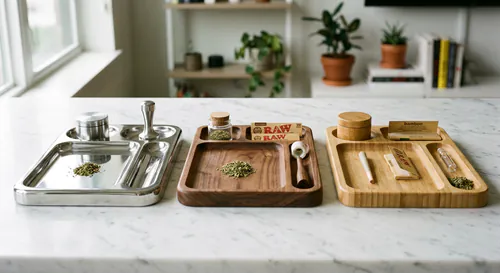
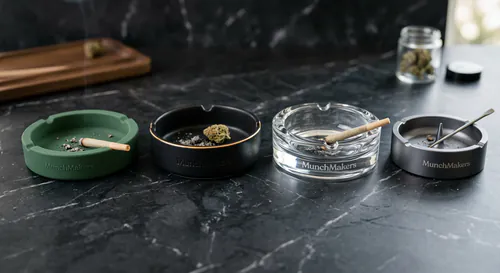
Metal ashtrays come in two distinct subcategories: decorative metal (usually stainless steel or aluminum with a finish) and debowler-style functional trays. They're quite different in purpose.
Decorative metal ashtrays are durable, clean easily, and accept laser engraving well. Brushed stainless with an engraved logo looks genuinely premium. The heat conduction is higher than ceramic, which means the piece itself warms up faster but also cools down quickly. For dispensary counters and commercial settings, metal holds up better over time than ceramic.
Debowler ashtrays are in a category of their own. The defining feature is a metal spike or point embedded in the surface that you press your bowl against to dislodge the ash cake inside without burning your fingers or needing a tool. For anyone who smokes from a pipe or bowl regularly, this is an incredibly useful feature. You've been burning your finger or looking for a pin every time you want to clear a bowl -- a debowler just eliminates that problem.
The spike is usually removable for cleaning. The rest of the ashtray is standard in function: a bowl shape with a flat base and usually a rest notch or two. Materials vary from silicone to metal to plastic. The silicone debowlers are the most practical because they're dishwasher safe and the spike pops out easily.
If you own a pipe or use a bowl with any regularity and you've never owned a debowler ashtray, I'd prioritize getting one over almost any other accessory. The improvement to daily use is disproportionate to the cost.
Novelty and specialty ashtrays
There's a large category of ashtrays designed primarily to look interesting rather than function optimally. Sculptural ceramic pieces, wooden carved trays, combination ashtray-stash boxes. These can be excellent or frustrating depending on whether the design interfered with function.
The things to check on any novelty piece: are the rest notches deep enough to hold a joint without it rolling off? Is the bowl deep enough that ash doesn't blow around? Is the surface easy to clean or is there texture that will trap resin? A beautiful ashtray that's annoying to actually use is not a good buy regardless of how it looks.
Combination ashtray-storage boxes are genuinely useful if you want to keep everything in one place. A lidded tray with a small compartment for papers, a filter tip booklet, and a lighter keeps your session setup compact and contained. For home use, these are worth considering over a standalone ashtray.
Outdoor ashtrays
For outdoor use specifically, the requirements are different. Wind becomes relevant -- a shallow bowl in a light breeze scatters ash everywhere. Look for deeper bowls and higher sides when choosing something for a patio, deck, or outdoor event space.
Weight matters outdoors too. A heavy ceramic piece won't tip easily but will break if it goes over on a hard surface. Silicone is genuinely the best choice for true outdoor use: light, stable-ish, completely unaffected by rain, and survives being knocked over without any consequence.
For permanent outdoor installation (a patio table that stays outside), stainless steel is the most weather-resistant option. It won't absorb moisture, won't crack in temperature swings, and cleans easily after being outside. Powder-coated aluminum is also good for outdoor use if you want more color options.
What to actually spend
The price range on ashtrays is enormous, from a few dollars to well over a hundred for art glass pieces. For daily use, you don't need to spend much. A solid silicone ashtray or a basic ceramic piece in the $10 to $25 range will function just as well as something five times the price.
Where it's worth spending more is on a piece you'll keep out permanently as part of how your space looks, or on a glass piece with real craftsmanship behind it. In those cases, the extra money is paying for aesthetics and durability, not function.
For anyone buying an ashtray as a gift or looking for something to give customers as part of a dispensary purchase, the ashtrays category includes options across the material range. And if you want to see how different ashtray types fit into a broader product category comparison, the rundown at different types of ashtrays goes deeper on the variations within each style.