What a custom rolling tray actually is (and why it matters)
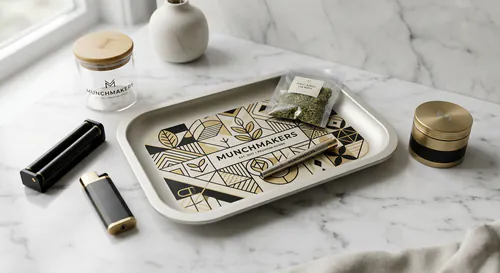
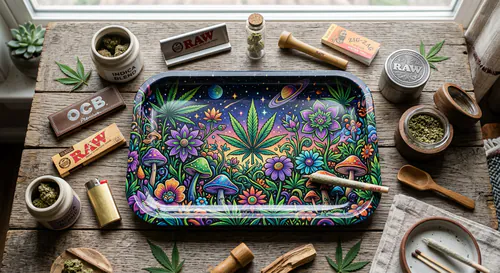
A rolling tray is a flat surface with raised edges that keeps your session organized. Herb, papers, a grinder, finished joints, all of it stays contained and doesn't end up on your couch or carpet. That's the basic version. A custom rolling tray is the same thing with your artwork, logo, or design printed or pressed onto the surface.
For a dispensary or cannabis brand, that distinction matters. The tray sits on a customer's desk or coffee table and gets looked at every day. It's not something they'll shove in a drawer. If the design is good, they might even show it off. That kind of organic visibility is genuinely hard to buy through advertising.
This guide covers everything you need to make a good decision about custom rolling trays: materials, print methods, size options, what to watch out for when ordering, and the details that separate a tray people keep from one they lose under a couch cushion.
Materials and what they feel like in practice
The material determines weight, surface quality, print options, and how long the tray holds up to daily use. There are three main options worth knowing.
Metal is the most common and, in most cases, the most practical. The majority of metal rolling trays are made from tinplate steel, which is thin, lightweight, and takes printed designs very well. The surface is smooth enough for precise rolling and easy to wipe clean. Tinplate is also inexpensive enough that it makes large orders economically feasible. The downside is that it dents if dropped from height and can scratch over time, though a scratched tray still functions fine. For a dispensary giveaway or branded merchandise, metal is usually the right call.
Wood trays have a different character entirely. The surface is warmer, the weight is more substantial, and they tend to look better in a home setting. For customers who think of their setup as something to display, wood reads as more intentional. The tradeoff is that printing on wood is more limited. Laser engraving works very well on wood and produces clean, lasting results. Full-color sublimation or UV printing is possible on some wood types but the color saturation isn't as vivid as on metal. If you want a premium product with a natural aesthetic, wood is worth the higher unit cost.
Bamboo is in the same general family as wood but has a few specific advantages. It's harder than most domestic woods, which means it resists scratching better. It's also a fast-growing grass, not a slow-growth tree, so brands that care about sustainability can make a credible claim there. Like wood, it works best with laser engraving or simple artwork rather than photo-quality prints.
Printing methods for custom rolling trays
How your design gets onto the tray affects color fidelity, durability, and minimum order quantity. The three methods you'll encounter most often are sublimation, UV printing, and screen printing.
Sublimation is the standard for metal rolling trays with full-color designs. The process uses heat to transfer dye directly into the surface coating, so the design becomes part of the tray rather than sitting on top of it. Colors come out bright and accurate, and the print won't peel or flake because there's no ink layer to separate from the substrate. Photo-quality artwork prints well. The limitation is that sublimation requires a white or light base coating to work properly, so if you want a dark or metallic background, you're looking at a different method.
UV printing cures ink with ultraviolet light almost instantly. It can work on darker surfaces and handles fine details well. The results are excellent and the method is faster than sublimation at small quantities. For runs under 50 units or for very detailed designs, UV printing is often the better fit. It costs more per unit at scale than sublimation but the setup fees are lower.
Screen printing transfers ink through a mesh screen onto the tray surface. It's the oldest method and still widely used for large production runs because the per-unit cost drops significantly at volume. Each color requires its own screen, so designs with two or three colors are practical but full-color gradients are not. If you have a clean logo with defined colors and you're ordering 500 or more units, screen printing will give you the best economics.
Size options and which one to choose
Rolling trays come in a range of sizes, typically categorized as small, medium, large, and XL. The exact dimensions vary by manufacturer, but the general ranges are useful as a guide.
Small trays are roughly 7 by 5 inches. They're fine for a single joint but feel cramped the moment you add a grinder and a pack of papers. They work as giveaway items or as part of a kit because they're inexpensive and easy to ship, but they're not what someone who rolls regularly will reach for.
Medium trays at around 10 by 6 inches are the most popular size. There's enough room to work comfortably without the tray feeling oversized on a nightstand or coffee table. For a custom product you want people to actually use, medium is the default choice.
Large trays at 12 by 8 inches give you real working space. You can have your grinder open on one side, herb in the middle, papers and a filter tip to the right, and nothing feels crowded. For customers who smoke with multiple people or who like an organized setup, large is worth it. It's also a bigger canvas for your artwork.
XL trays, sometimes 14 by 10 inches or larger, are a statement. They're less portable but some customers specifically want a tray that dominates the coffee table. They're less common as branded giveaways because the shipping cost per unit is meaningfully higher.
The print area on any tray is typically the full bottom surface, so larger trays don't just give users more space, they give you more room for your design. A detailed illustration or a full-background pattern that would feel busy on a small tray can look great at large format.
Magnetic lids: worth it or not?
A tray with a matching magnetic lid is a different product category from an open tray, and it's worth understanding what you're paying for.
The rolling tray with magnetic lid solves a specific problem: a loose tray full of herb and papers is a spill waiting to happen, especially if you're moving from room to room or if you have pets or kids. The lid clicks into place magnetically and keeps everything inside. It also provides a degree of smell containment, which some customers care about a lot and others not at all.
From a branding perspective, you now have two printable surfaces: the inside of the tray and the outside of the lid. Some brands use the outside of the lid as the primary logo placement and leave the inside with a simpler design or plain surface. Others go full coverage on both. The lid also makes the whole unit feel more premium, which affects how customers perceive your brand.
The tradeoff is cost. A lidded tray costs more to produce and more to ship. For a flagship branded product that you sell rather than give away, it's usually worth it. For a high-volume giveaway where economics matter, an open tray at better per-unit cost is often the smarter choice.
What affects the minimum order quantity
MOQ varies more in rolling trays than in other accessories because the manufacturing process is more setup-intensive.
For sublimation printing on metal trays, the setup involves coating the trays and preparing the transfer paper for each design. This means even small runs require some upfront work. Many manufacturers set minimums at 50 to 100 units for sublimation, though some suppliers who specialize in the cannabis market will go lower for premium clients.
Screen printing has the highest MOQs because of the screen setup cost for each color. Expect minimums of 200 to 500 units. The per-unit pricing at those volumes drops enough to make it attractive for dispensaries running large campaigns.
UV printing and laser engraving can usually be done in smaller quantities, sometimes as few as 25 units, because the setup costs are lower or non-existent. If you're testing a design before committing to a large run, these are the methods that let you do that without a painful minimum.
Lead time on custom rolling trays ranges from 2 weeks for simple designs with domestic production to 6 to 8 weeks for overseas manufacturing with complex artwork. Factor that into any campaign planning. A product that arrives a week after your event is useless.
Design decisions that actually matter
The tray is a flat rectangle. What you put on it is largely up to you, but there are some decisions that consistently separate trays people use and display from trays that feel like an afterthought.
Full bleed backgrounds almost always look better than centered logos on a white or plain surface. A logo floating in empty space looks like a proof, not a finished product. Fill the canvas. A background color, a pattern, a texture, or an illustration that covers the full surface makes the tray feel designed.
Dark backgrounds photograph better in lifestyle settings. A tray with a black or dark navy background shows up clearly against most surfaces people set it on. Light backgrounds can wash out against light-colored furniture.
Typography on trays works best when it's large and simple. A brand name in a clean typeface at 60 to 80 percent of the tray width is more effective than a paragraph of small text. The tray is not a business card. People looking at it from across the room should be able to read the brand name.
Think about the actual use context. The tray will be used. Herb will fall on it. It'll be wiped down with a damp cloth. A design with very dark colors everywhere hides residue well. A design with a lot of white or very light areas will show residue more obviously. That's not a reason to avoid light designs, but it's worth knowing.
The ordering process, step by step
Getting from idea to finished product is usually a 5-step process, and each step has common sticking points.
Step 1 is choosing your material and size. For most dispensaries, this means metal, medium or large, sublimation or screen printing depending on order size. That decision should come before you finalize artwork because the print method affects the color profile you design in.
Step 2 is preparing your artwork. You want vector files for logos and text (AI, EPS, or SVG formats). If you have a photo-based design, provide it at the highest resolution you have. The manufacturer will give you a template with exact dimensions and bleed requirements. Designing outside that template is a common mistake that causes delays.
Step 3 is submitting the order and reviewing the digital proof. A reputable supplier will send back a mockup showing your design on the tray before production starts. Review it carefully. Check that colors look right, that text is readable at the expected size, and that nothing got cropped at the edges. This is your last easy chance to catch a mistake.
Step 4 is production. Once the proof is approved, the clock starts. For overseas manufacturing, this typically takes 3 to 5 weeks. For domestic production, it can be as fast as 7 to 10 business days.
Step 5 is quality check on arrival. Open a random sample from the shipment before accepting or distributing. Check that colors match the proof, that the tray surfaces are clean and undamaged, and that any lids or accessories (if ordered) function properly. Catching a production defect early gives you time to work with the supplier on replacements before your campaign date.
Custom rolling trays as part of a larger merch strategy
A tray by itself is a good branded product. A tray paired with a matching grinder and a branded lighter is something customers show people.
The most effective branded accessory programs we've seen treat the full session setup as the canvas. Customers do everything in a consistent branded environment: the grinder, the tray, the storage. When all of those items carry the same design language, it reads as a real brand rather than a one-off giveaway.
MunchMakers supplies the full range, so coordinating artwork across product types is something we can actually execute, not just theorize about. If you're building a complete branded lineup, it's worth thinking about the tray as one piece of a larger system rather than an isolated order.
For a deeper look at how to customize a tray from scratch including DIY options for individuals, the guide at blank rolling trays customization covers that angle thoroughly.
Common mistakes and how to avoid them
The most frequent issue I see is customers providing low-resolution artwork and expecting sharp results. A logo from a website is typically 72 DPI and designed to display on screen, not to print at 10 inches wide. At print size, it looks pixelated. Always provide the original vector file or at minimum a 300 DPI raster at the actual print dimensions.
The second most common issue is ordering without seeing a physical sample first for large runs. Digital proofs are useful but they don't tell you how the color will look under warm light versus cool light, or how the tray feels in hand. For orders over 200 units, requesting a physical pre-production sample costs maybe $30 to $50 and can save you from approving 300 trays that don't look the way you expected.
The third issue is underestimating lead time, especially for first-time orders. The first time you work with a new supplier, add two weeks to whatever timeline they quote. There's almost always a round of revision on the artwork and at least one back-and-forth on the proof. Once you have an established relationship and approved templates, reorders go much faster.
Custom rolling trays are one of the more durable branded items in the cannabis accessories space. They're large enough to display artwork properly, useful enough that people keep them, and cost-effective at the volumes that make sense for a real marketing campaign. Get the design and the spec right the first time, and you'll have a product that earns its keep long after the order date.