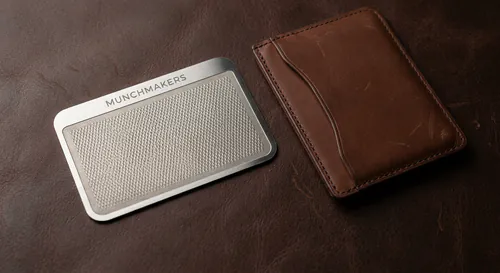
A grinder card is exactly what it sounds like: a flat, credit-card-sized piece of metal punched with small holes that work like a cheese grater. You hold your herb over the card, rub or press it across the surface, and the material falls through onto whatever you're rolling on. The whole thing fits in your wallet, weighs almost nothing, and costs somewhere between three and twelve dollars.
I'll be direct about what they are and what they aren't. If you're hoping to find a genuine replacement for a proper grinder in card form, this isn't it. But for a specific type of user in a specific situation, a grinder card earns its place.
How grinder cards actually work
Most grinder cards are made from stainless steel or anodized aluminum. The grinding surface is a grid of raised, sharp-edged holes stamped through the metal. You hold the card over a tray, paper, or your palm, and drag herb across it. The ground material falls through or collects on the card face depending on which way you orient it.
Some versions have a slight curve pressed into the card to funnel material toward a collection point. A few have a folded lip along one edge. Neither design fully solves the scatter problem, which we'll get to.
The grinding action itself is rougher than what you get from a rotary grinder with diamond-cut teeth. You end up with an uneven mix of fine dust and larger chunks unless you're deliberate about grinding pressure and technique. For joints or blunts where grind consistency matters less, this is acceptable. For a vaporizer, it's not ideal.
The real pros
Portability is genuinely hard to beat. I've had a grinder card sit in my travel wallet for three months without me thinking about it. It adds no noticeable bulk, goes through airport security without issue (it's just a piece of metal), and doesn't roll out of a pocket the way a cylindrical grinder can.
Discretion is another legitimate advantage. A grinder card looks like a multi-tool card or even a bottle opener card from a distance. Most casual observers won't identify it. If you're somewhere that calls for low-profile equipment, a card beats a grinder.
Cost is almost trivially low. Spending $6 on a backup you keep in your wallet while your main grinder stays at home is not a hard decision.
The real cons
No kief catcher. This is the big one. Every bit of trichome dust you grind falls wherever it falls: onto your tray, into your lap, onto the table. You lose a meaningful amount just through the process. If kief collection matters to you, a grinder card isn't going to work.
The mess factor is real. Without a chamber to collect ground material, you're grinding over something and hoping it doesn't scatter. Wind, an uneven surface, or a moment of distraction all cost you product.
Grind consistency is inconsistent. You get some coarse bits, some fine powder, not the uniform fluffy grind a good rotary grinder produces. For rolling it's workable. For packing a bowl or loading a vape, it takes more effort to get a usable result.
The cards also wear out. The teeth flatten with regular use, and a flat grinder card grinds even less efficiently than a new one. Most people who use them heavily replace them every few months.
Grinder card vs mini keychain grinder
This is the comparison that actually matters. A mini keychain grinder is only marginally larger than a grinder card and does meaningfully more. You get a proper rotary grinding mechanism, two or three pieces, and a real collection chamber. The grind quality is vastly better. The trade-off is that it clips to your keys, not your wallet, and it's visible and identifiable as a grinder.
If pocket real estate is your constraint, go keychain grinder. If wallet portability is genuinely the priority, the card makes sense. These are different solutions to slightly different problems.
Against a standard grinder, there's no real competition. A proper 4-piece grinder wins on grind quality, kief collection, and longevity. The grinder card wins only on portability and price.
Who should buy one
You travel frequently and want something disposable-cheap in a travel wallet. You already own a proper grinder at home and want a backup that costs nothing to lose. You're primarily rolling joints and don't care much about consistency. You need something that doesn't look like paraphernalia at a glance.
Who should skip it
You use a vaporizer and need a fine, even grind. You want to collect kief. You're buying a first grinder and want something you'll actually enjoy using. You roll in places where mess is a problem. You smoke frequently enough that a real grinder pays for itself in better results within a month.
Buyer checklist
If you decide a grinder card fits your needs, here's what to look for before buying:
- Stainless steel over aluminum -- stainless holds its edge longer and doesn't shed material into your herb
- Hole uniformity -- look for consistent stamping across the card surface; uneven holes mean uneven grind
- Edge finish -- sharp unfinished edges on a card you're handling constantly will cut you; look for smoothed or folded edges
- A collection lip or channel -- small but useful for directing material instead of losing it everywhere
- Avoid overly cheap zinc alloy versions -- they flake tiny metal particles into your herb over time, which you don't want to smoke
For most situations, though, I'd point you toward custom grinders that actually do the job well. A grinder card is a clever compromise, not a solution. Knowing the difference is what matters when you're deciding what to carry.
If you're still figuring out what size or configuration actually fits how you smoke, it's worth reading up on how to choose the right grinder size and piece count before you spend money on anything.
And if you're outfitting a full kit, the cannabis accessories section has everything worth pairing with a grinder -- rolling papers, trays, filters, the works.