Windproof lighters: how they work, best designs, and when you actually need one
Most lighter failures happen outdoors. You're at a beach, a rooftop, a festival, a trailhead, and the standard soft-flame lighter in your pocket flickers and dies every time you try to get it going. You cup your hands, you turn away from the wind, you try seven times. This is a solved problem. Windproof lighters exist specifically for this situation, and they work.
The question is which type of windproof lighter is right for you, because not all windproof designs use the same mechanism and the differences matter in real conditions.
How windproof lighters work
Standard soft-flame lighters are vulnerable to wind because the combustion zone is open. The flame sits at the end of an exposed gas stream, and any air current disrupts the mixture of butane vapor and oxygen that combustion requires. Enough wind and the flame blows out entirely.
Windproof designs solve this in different ways depending on the mechanism.
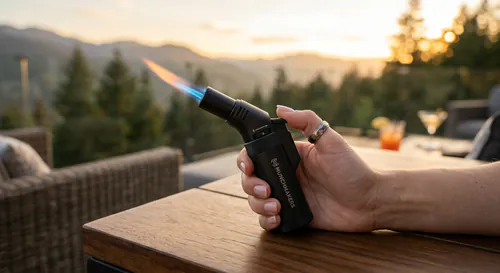
Double and triple-jet torch lighters force butane through narrow nozzles under pressure. The combustion happens in a concentrated, high-velocity stream that wind physically can't overpower at typical outdoor conditions. The blue flame of a torch lighter isn't just hotter; it's structurally resistant to disruption because of the pressure differential that creates it. A quality dual-jet torch will stay lit in winds up to 30-40 mph in my experience, which covers nearly any realistic outdoor situation.
Zippo-style chimney lighters use a different approach. The wick and flame chamber are surrounded by a perforated metal chimney that shields the combustion zone while still allowing airflow for oxygen. They're not impervious to wind the way a torch is, but they handle moderate conditions well. The tradeoff is the naphtha fuel requirement and the evaporation issue, but the windproof performance is reliable in everyday outdoor use.
Electric arc lighters (plasma lighters) don't use flame at all. Two electrodes generate a plasma arc when activated, producing enough heat to ignite materials that touch the arc. There's nothing to blow out because there's no combustion happening in open air. They're completely windproof and waterproof in most designs, though you can't use them to light a candle or anything that requires directing a flame into a recessed space. They also require USB charging and the arc is short-range. For lighting joints or cigarettes directly, they work well. For anything else, they're limited.
Coil-style electric lighters heat a metal coil to ignition temperature rather than generating an arc. Same windproof principle as plasma, same limitations around open flame. The coil glows orange and transfers heat on contact.
Wind resistance in real conditions
These categories perform differently in actual wind rather than ideal test conditions. A single-jet torch holds up to light wind but can struggle above 15 mph depending on flame angle. A dual-jet is significantly more resistant. The best triple-jet models from quality brands handle heavy outdoor conditions with no issues. Plasma arcs are effectively immune to wind. Zippo-style chimneys sit between single-jet and dual-jet in practice.
Temperature also matters in ways that marketing doesn't always mention. Below about 40°F, butane doesn't vaporize efficiently, so cold-weather outdoor use puts most butane-based windproof lighters at a disadvantage. Zippos, which use naphtha, perform better in cold conditions. Plasma lighters are temperature-resistant because they're battery-powered. If you're regularly outdoors in cold climates, this is worth factoring into your choice.
Fuel types for wind resistance
Butane (standard and triple-refined) works well for torch lighters in most conditions. Triple-refined butane matters more in torch lighters than in soft-flame designs because the nozzle precision is higher. Use the wrong butane and you'll clog the nozzle within a few refills.
Naphtha (lighter fluid) for Zippo-style designs. Ronsonol is the standard. Keep a small supply if you use a Zippo regularly because the fuel evaporates whether you use the lighter or not.
Electric lighters need only USB power. Convenient for charging on a battery pack during multi-day outdoor trips, but battery depletion in remote settings is a real consideration.
Best situations for windproof lighters
Outdoor concerts and festivals are the most common real-world use case. The combination of crowding (you can't always turn your back to the wind), constant movement, and high frequency of use makes a reliable windproof lighter notably better than fumbling with a BIC for twenty seconds.
Beach use is another obvious one. Sand and wind together are particularly hostile to soft-flame lighters. The particulate issue from sand can also clog nozzles, so a simpler mechanism (arc or coil) has some advantage over precision torch nozzles in sandy environments.
Hiking and camping. For backcountry use, most people carry dedicated fire-starting tools (lighters plus waterproof matches as backup), but a good windproof lighter is part of that kit. A plasma lighter with a full charge or a fresh-fueled torch is better than a BIC for making fire in exposed conditions.
Cigar smoking outdoors. Cigars require an even toasting that's very difficult to achieve when the flame keeps blowing out. A dual or triple-jet torch is probably the most useful outdoor tool for dedicated cigar smokers.
Custom windproof options
For brands that market to outdoor, adventure, or active lifestyle audiences, windproof lighters are a better-fit promotional product than standard soft-flame designs. The perceived utility is higher, and the lighter is more likely to be used in exactly the situations where someone would want your brand visible. A custom dual-jet torch with a good print is a memorable merchandise item in a way a standard BIC isn't for these audiences.
Our custom lighters include windproof formats, and our metal windproof lighter is a popular option for outdoor-brand custom work. For a comparison of torch versus standard flame performance, the torch lighter comparison guide covers the specifics. The complete lighter types guide is worth a read if you're deciding between multiple formats.