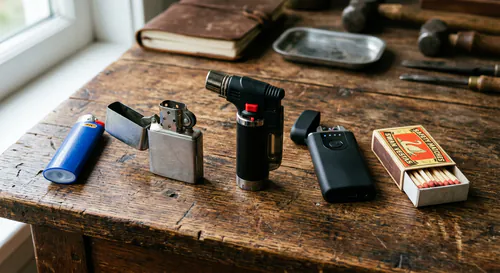
There are 7 functional categories of lighters in common use: disposable plastic (BIC, EZ Wider), refillable butane with flint (Clipper, Zippo), refillable soft-flame (Cricket), torch (jet, single or multi-flame), plasma arc (USB-rechargeable, no fuel), candle/utility (extended-reach), and electric resistance (no flame at all). Each wins in different scenarios — wind resistance, cost, refill convenience, and dispensary use case.
Below: side-by-side comparison plus which categories make sense to stock as custom-branded dispensary swag.
Disposable lighters
The disposable lighter is the default option for most of the world, and BIC built an empire on that fact. These are butane-fueled, flint-sparked, and designed to be used until the fuel runs out. They're not meant to be refilled. When they're done, they're done.
The appeal is obvious: they cost under a dollar at retail, work reliably in most conditions, and fit in any pocket. The flame is soft (meaning it disperses rather than directing tightly), which makes them suitable for cigarettes, joints, candles, campfires, and stove burners. For general everyday fire starting, a standard disposable lighter handles maybe 90% of situations without complaint.
BIC specifically has earned its reputation through consistency. Their flint mechanism and butane valve are engineered tightly enough that quality variance is low across hundreds of millions of units. Generic disposable lighters from unknown manufacturers can be hit-or-miss — the flint wheel sticks, the flame adjusts unpredictably, or the fuel runs dry faster than expected.
The main downside is environmental. A disposable lighter is plastic, and once it's empty it goes in the trash. This bothers some people more than others. If ecological footprint is a concern for you, a refillable lighter is the obvious answer. If you're using lighters in volume — say, running a dispensary and giving them away — the disposable economics make more practical sense.
Refillable lighters
Refillable lighters are built to last years rather than days. You buy butane or lighter fluid separately, top the tank off when it runs low, and the lighter continues working indefinitely (or until you lose it, which is the more likely end state).
Two fuel types divide this category: butane and liquid naphtha (lighter fluid). Butane refillables (the kind you refill via a valve at the bottom) are common in slim metal designs and torch formats. Naphtha-fueled refillables — Zippo being the most famous example — work differently: they use a cotton wick and felt reservoir saturated with lighter fluid, and a flint-and-wheel ignition. Zippo's wick-and-flint design makes it windproof, which is a genuine functional advantage, not just marketing.
Refillable lighters sit higher on the perceived-quality scale. Handing someone a Zippo is different from handing them a BIC — it communicates something about the giver. This is why refillable lighters, especially metal-body models, are popular for gifts, engraved mementos, and premium promotional applications. A metal lighter with a laser-engraved logo will outlast anything printed on plastic.
The practical inconvenience is that you need to keep a supply of butane or lighter fluid on hand. Running dry at an inconvenient moment is the refillable lighter's Achilles heel. Some people manage this by keeping a disposable as a backup, which somewhat defeats the purpose, but that's how people actually use them.
Torch / jet flame lighters
Torch lighters produce a concentrated, narrow flame driven by compressed butane under higher pressure than a standard soft-flame lighter. The result is a wind-resistant, very hot, precise flame that doesn't waver the way a standard lighter does.
Cigar smokers favor torch lighters because you can char and light the foot of a cigar evenly without the soft flame touching the tobacco and altering the taste. The directed flame lets you control exactly where the heat goes. Cannabis users who dab concentrates often use torch lighters for the same reason — a single-flame or triple-flame torch gets concentrates to the right temperature quickly and evenly.
Most torch lighters are butane refillable, which makes ongoing fuel cost reasonable. Single-flame torches ($5 to $20) are the most common and sufficient for cigar lighting and most household uses. Triple-flame and quad-flame torches are for people who want to light a 60-ring-gauge cigar with maximum efficiency. The wider the cigar, the more useful a multi-flame design becomes.
What torch lighters are not good for: candles (too aggressive, the flame overshoots the wick and can drip or spatter wax), cigarettes and joints unless you're careful (the directed flame creates a harsh spot rather than an even light), and general use around paper or flammable materials. They're a specialist tool, not a general-purpose one.
Temperature is also worth noting. A standard soft-flame lighter burns at roughly 1,800 to 3,500 degrees Fahrenheit. A butane torch flame runs around 3,500 to 4,800 degrees Fahrenheit. This is why torches work for dabbing, glass work, and soldering in a pinch — and why you need to be more careful with them.
Electric / plasma lighters
Plasma lighters are the newest category on this list and they work completely differently from everything else. Instead of combustion, they use electricity to create a plasma arc — a beam of superheated ionized gas — between two ceramic electrodes. There's no flame, no fuel, no flint. You charge them via USB and they produce a small but intensely hot arc on demand.
The genuine advantages: they're windproof to a far greater degree than any butane lighter because there's no flame to blow out. They don't require fuel, so no running dry at inconvenient moments. Many people find them reliable for candles, incense, and cigarettes, where the plasma arc easily ignites the wick or paper.
The limitations are real though. The arc is small and precise, which makes it difficult to light a campfire, stove burner, or anything that needs heat applied over a larger surface. Battery life is typically 100 to 200 uses per charge, which is fine for moderate daily use but might not be enough for heavy users. And they're more expensive at the entry level — a basic plasma lighter runs $10 to $25, versus under a dollar for a disposable BIC.
For a certain type of person — someone who hates carrying butane, values windproof performance, and lights candles or cigarettes regularly — a plasma lighter genuinely makes sense. For most people, the novelty wears off and they end up back on disposables.
Zippo-style lighters (naphtha wick lighters)
Zippos deserve their own category because they have a distinct design, a distinct fuel, and a genuinely devoted following. The hinged metal case, the satisfying click when you open and close it, the thumb-wheel flint striker — these are tactile details that turn a lighter into something people actually care about.
The windproof claim is the most practical advantage. A Zippo's wick design maintains combustion in conditions where a BIC flame dies completely. If you're frequently lighting things outdoors in wind — campfires, grills, cigarettes on a boat — a Zippo or a naphtha-fueled windproof lighter has a real functional edge.
The drawback is naphtha fuel evaporation. Unlike butane lighters that hold fuel until you use it, a Zippo filled with lighter fluid will slowly evaporate even when you're not using it. Leave a filled Zippo in a drawer for two weeks and it may be dry when you come back to it. This is the main reason people cycle between Zippos and other lighters rather than relying exclusively on one.
From a gift or collectible perspective, Zippos are in a class of their own. Engraved or custom-painted Zippos are common gifts for groomsmen, military commemorations, and personal milestones. The lighter can be refilled indefinitely and handed down, which gives it a kind of permanence that a disposable doesn't have.
Candle lighters / utility lighters
These are the long-neck lighters — typically 10 to 12 inches in length — designed for situations where a standard lighter would burn your fingers. Lighting candles deep in a glass jar, reaching into a fireplace, igniting a gas grill, lighting the back burners of a stove. The extended neck keeps your hand away from the heat source.
Most utility lighters are piezoelectric (push-button ignition, no flint or wheel required), which makes them easier to use with one hand or for people with limited grip strength. They're butane refillable, though some cheaper models are single-use.
Nobody carries a utility lighter in their pocket. It's a kitchen or hearth tool. If your home has candles, a gas range, a fireplace, or a grill, you probably want one of these. They're typically $5 to $15, with refillable models worth the small premium over disposable versions.
Pipe lighters
Pipe smokers know this category well; most other people don't. A pipe lighter has a specific design accommodation: the flame comes out at a 90-degree angle (or on a curved stem) so that you can hold the flame over the bowl of a pipe while tamping without burning your knuckles. Lighting a pipe with a standard lighter requires an awkward wrist angle that gets uncomfortable fast.
Some pipe lighters are soft-flame butane, others are soft-touch naphtha. Almost all are refillable, because pipe smokers tend to be deliberate about their equipment. Prices range from $15 to $60 for quality models from brands like Colibri or S.T. Dupont.
Unless you smoke a pipe, you don't need a pipe lighter. But if you do, using anything else is noticeably inconvenient.
Matchbooks and strike-anywhere matches
Technically not lighters, but worth mentioning because matchbooks still occupy a genuine niche. Strike-on-box safety matches and strike-anywhere matches are low-cost, flame-producing tools that require no fuel management or battery charging. For emergency kits, camping, and power outages, waterproof matches are often the most reliable option.
From a promotional standpoint, matchbooks with custom printed covers were a classic marketing item for decades (bars, restaurants, hotels all used them). They've been largely displaced by custom lighters, but for certain brand aesthetics — vintage, rustic, hospitality — custom matchboxes still have appeal.
Choosing the right lighter for your needs
The honest answer is that most people are well served by a standard disposable lighter for everyday use and don't need to think beyond that. But the right choice depends on your specific situation:
If you smoke cigarettes, joints, or use candles frequently: a quality disposable or refillable soft-flame lighter. BIC for reliability, a refillable for better long-term economics and reduced waste.
If you smoke cigars: a single or triple-flame torch lighter. The controlled, wind-resistant flame is worth the extra cost and the learning curve.
If you dab concentrates: a butane torch (the larger, dedicated kind rather than a pocket lighter) for most rigs, or a quality torch lighter for portable use.
If you're primarily lighting candles indoors: a utility lighter or plasma lighter. Both keep your hand safe and work reliably for wick ignition.
If you want a long-term keepsake or gift: a metal refillable lighter or Zippo, ideally with custom engraving.
If you need something for custom branding or promotional use: custom lighters in the disposable BIC category are the standard choice for scale, but premium custom metal lighters work well for targeted gift applications. See our full breakdown in the custom lighters branding guide for everything you need to know about promotional options.
For a deeper look at the torch lighter category specifically, our guide on custom torch lighters covers design and function in more detail.
A note on fuel safety
Whatever lighter type you use, a few safety basics apply. Store butane canisters away from heat sources — a butane can in direct sunlight or near a heater is a pressure hazard. Don't fill a butane lighter immediately after it's been in use; let it cool first. Keep lighters out of reach of children, and don't hold a flame near your face or hair when lighting candles in tight spaces. None of this is complicated, but lighter accidents are preventable with basic awareness.
If you're buying in bulk for retail or promotional distribution, make sure your disposable lighters meet child-resistant safety standards (CR compliant) as required by the Consumer Product Safety Improvement Act. Reputable suppliers will confirm compliance without being asked.
Final thoughts
There's a lighter for every situation, and most situations call for the humble disposable. But if you smoke cigars regularly, are planning a promotion, or want to give someone a lighter as a meaningful gift, the decision is worth thinking through. The categories above cover everything you're likely to encounter, and the distinctions between them are real rather than marketing-generated.
A BIC in your pocket. A torch on the cigar shelf. A Zippo in a gift box. Each one is the right tool for something specific, and a poor fit for something else.