What you're actually choosing when you pick a rolling paper
Most smokers spend more time picking a strain than they do picking a paper. That's backwards. The paper you use affects burn rate, flavor, how much you taste your herb versus the paper itself, how easy the joint is to roll, and how the whole thing burns from start to finish. A cheap paper can ruin good herb. A great paper disappears.
This guide covers everything: materials, sizes, thickness, brands worth knowing, and what to actually look for if you want papers that suit the way you smoke. I'm going to give you my real opinions, not a list of every brand on the market.
Rolling paper materials
The material is the single biggest factor in how a paper burns and tastes. There are four main ones you'll encounter.
Wood pulp
Wood pulp is the traditional material, and it's what the white or off-white papers in most gas stations are made from. It's what your grandparents rolled with. Wood pulp papers are easy to handle because they're slightly stiff, which makes them forgiving for beginners. They hold their shape while you're rolling, and they burn at a consistent rate.
The downside is that you can taste the paper. Not overwhelmingly, but it's there, a faint papery flavor that sits underneath the herb. For people smoking high-quality flower, that's a real issue. Wood pulp papers also tend to burn slightly faster than rice or hemp, which means more smoke per puff relative to the herb itself.
If you're a casual smoker, rolling with friends, or you just need something that works without fuss, wood pulp is fine. If flavor purity matters to you, there are better options.
Rice paper
Rice papers are thin, almost transparent, and they burn incredibly slowly. The slow burn means you get more out of your herb because you're inhaling herb smoke rather than paper combustion. When rice papers are made well, they're nearly flavorless -- the herb comes through clean.
The trade-off is that rice papers are harder to work with. Because they're thin and slick, they don't stick to themselves easily during rolling. Humidity affects them noticeably -- on a dry day the paper can crack slightly, on a humid day it can get limp and lose its grip. If you're an experienced roller, rice papers are excellent. If you're still learning, they'll frustrate you.
Brands like Elements and Randy's make rice papers that are genuinely good. The burn is slow enough that a joint you rolled 20 minutes ago will still be structurally intact when you light it, rather than having gone stale or warped.
Hemp paper
Hemp papers occupy a comfortable middle ground. They're slightly thicker than rice but still burn more slowly than wood pulp. The taste is earthy and mild -- slightly more present than rice but far less intrusive than wood pulp. Hemp papers are also more environmentally consistent than tree-derived papers if that matters to your purchasing decisions.
Hemp papers also tend to be off-white or light brown, which is a visual cue that there's no bleaching involved. Many people prefer unbleached papers on principle, and hemp papers make that easy to find.
RAW's hemp papers are probably the most widely used in this category. They hold up well in humidity, roll smoothly, and burn consistently. They're my default recommendation for people transitioning from wood pulp who want something cleaner without the difficulty of rice.
Cellulose (clear) papers
Cellulose papers are made from plant cellulose and are completely transparent. No flavor, almost zero combustion byproduct. They're visually interesting and genuinely do what they claim in terms of flavor neutrality.
The practical issue is stiffness. Cellulose papers don't soften and conform the way paper does. Rolling with them takes practice. They also seal differently -- you lick the gum strip and it takes a moment to bond. Some people love them. Others try them once and go back to hemp.
If you want the purest possible expression of your herb with zero paper flavor, cellulose is worth trying. For regular rolling, they're more of a novelty than a daily driver.
Rolling paper sizes explained
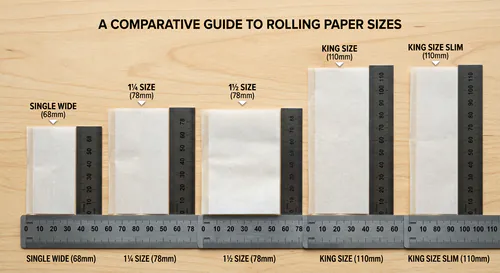
Size matters more than most beginners realize. The right size depends on how many people are sharing, how much you typically smoke, and your rolling style. Here's the full breakdown.
| Size | Dimensions (approx.) | Herb capacity | Best for |
|---|---|---|---|
| Single wide | 68 x 34 mm | 0.25 to 0.5g | Solo sessions, small hands, tight rolls |
| 1 1/4 (standard) | 78 x 45 mm | 0.5 to 0.75g | One to two people, most popular size |
| 1 1/2 | 78 x 60 mm | 0.75 to 1g | Slightly fuller joints without going king size |
| King size | 100 to 110 x 55 mm | 1 to 1.5g | Groups, longer sessions, parties |
| King size slim | 105 to 110 x 42 mm | 0.75 to 1.25g | Longer but not fatter, cigar-style shape |
| 98 Special | 98 x 60 mm | 1 to 1.5g | Popular in North America, between standard and king |
| Double wide | 78 x 88 mm | 1.5g+ | Very fat joints, novelty/party use |
For a deeper look at choosing the right size for your rolling style, read our rolling paper sizes guide.
The 1 1/4 size is the global default. Most pre-rolled cones you buy at a dispensary are 1 1/4. It's the size most tutorials assume you're using. If you're new to rolling, start here.
King size slim is worth mentioning separately because a lot of people don't realize it exists until they've been rolling for a while. It gives you a longer joint without making it fatter, which produces a slower burn and a more elegant smoke. RAW and Zig-Zag both make king size slim papers that I use regularly.
Thickness and burn rate
Papers are measured in grams per square meter (GSM). Lower GSM means thinner paper. Standard ranges:
Ultra-thin papers run around 10 to 13 GSM. These burn the slowest and contribute the least flavor. They're what most premium rice papers fall into. Standard papers are 13 to 16 GSM. Hemp papers generally fall here -- still clean but more forgiving. Regular wood pulp papers are 16 to 20 GSM. Reliable, slightly faster burn.
Thinner isn't always better. An ultra-thin paper in the hands of a beginner will burn unevenly (called canoeing) if the roll has air pockets or uneven density. A slightly thicker paper is more forgiving because it burns consistently even if the pack isn't perfect.
My take: if you've been rolling for more than a year and you can produce a consistent tight roll, go thin. If you're still learning, the marginal flavor improvement of going ultra-thin isn't worth the frustration of watching one side burn twice as fast as the other.
Flavored papers
Flavored papers exist, and I'll be honest -- I don't like most of them. They're usually wood pulp papers with artificial flavoring added. The flavor overpowers the herb, which defeats the purpose of smoking good herb. A blueberry paper doesn't make your joint taste like blueberries and your strain. It makes it taste like blueberry candy with a vague herbal backdrop.
The exception is naturally flavored or terpene-infused papers, which are subtler. But even then, they change the experience. If you spent money on a good strain, let it speak for itself.
There's one legitimate use case: flavored papers can improve the experience of low-quality or harsh herb where you want the flavor masked. But that's not an endorsement so much as an honest observation.
Gum strips
The gummed edge is how you seal the joint. Two types matter: natural gum arabic and synthetic adhesive. Natural gum arabic (made from acacia sap) is what most quality papers use. It's water-activated, food-safe, and bonds cleanly. Synthetic adhesives are found on cheap papers and they can taste strange, especially when dry.
You want a gum strip that's wide enough to give you a good seal (roughly 3 to 5mm), activates with minimal saliva, and doesn't leave a visible gap or bubble when it dries. Most brand-name papers have this right. The ones that don't are usually the no-name gas station packs.
Brand overview
Rather than ranking brands 1 through 10, I'll give you an honest take on the ones that have earned consistent quality.
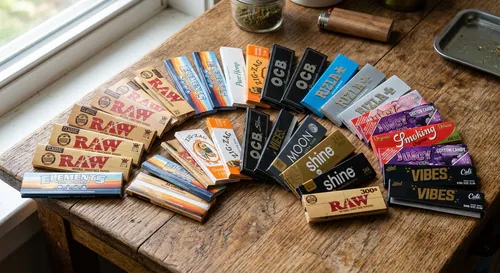
RAW is the most recognizable name in the market right now, and the reputation is mostly deserved. Their Classic hemp papers are consistent and available everywhere. RAW Organic hemp is slightly cleaner. RAW Black is their ultra-thin line. The brand consistency across product lines is good, which matters when you're buying in a new city and want to know what you're getting.
Elements makes rice papers that are some of the best available. The ultra-thin rice papers burn exceptionally slowly. If rice paper performance is your priority, Elements is where I'd send you first.
Zig-Zag has been around since 1879. The orange pack (French Orange) is a wood pulp paper and one of the most-rolled papers in history. It's not the cleanest burn available today, but the quality is consistent and the papers handle well. Good for beginners. The Zig-Zag ultra-thin line performs better for flavor.
Rizla is the European equivalent of Zig-Zag in terms of market presence. The blue Rizla (medium thickness) is a wood pulp paper that rolls well. Rizla Silver is thinner. In the UK, Rizla is what most people picture when they think "rolling paper."
OCB makes some underrated papers. Their Organic Hemp line and their Slim papers are genuinely excellent and tend to be more affordable than RAW. In France, OCB is the dominant brand. They're worth seeking out if you want to spend less without downgrading quality.
Juicy Jay is the main brand if you want flavored papers and actually want them done reasonably well. They use natural food-grade flavoring and the papers are decent quality. I still wouldn't recommend flavored papers for most smokers, but if someone in your group wants them, Juicy Jay is the version to get.
Filter tips (crutches)
You can't talk about rolling papers without addressing filter tips, because papers and tips go together. A filter tip (also called a crutch) is a small piece of thicker card that you roll at the mouthpiece end of your joint. It does three things: keeps the end from collapsing, prevents herb from pulling into your mouth, and gives structural support to the roll.
Most rolling paper brands now include a booklet of tips with their papers, or sell them separately. RAW's perforated tips are good. Some people prefer thicker card for firmer tips; others prefer flexible card that rolls more easily.
You can also use pre-made glass tips or reusable metal tips for a cleaner experience. The flavor difference from glass versus card is minimal, but the feel is different -- some people strongly prefer one over the other.
If you're just starting out and not using filter tips, start. The improvement in rolling control and smoking experience is immediate.
Pre-rolled cones
Pre-rolled cones deserve a mention because a large portion of people who think they need rolling papers actually want cones. A cone is a paper pre-rolled into the cone shape with a tip already attached. You fill it from the open end, pack it down, and twist the top closed. No rolling technique required.
Raw Cones are the dominant brand. They come in 1 1/4, King Size, and other sizes. The paper quality is the same as RAW's regular papers, which is good. If you struggle with rolling or you're in a situation where you want to roll quickly, cones are a completely legitimate choice.
The only reason to prefer hand-rolled over cones is control. When you roll yourself, you can adjust the density, shape, and size of each joint. Cones produce more uniform results but less customizable ones.
Custom and branded rolling papers
Beyond personal use, rolling papers have become one of the most effective marketing products in the cannabis space. Custom rolling papers with a dispensary or brand logo are something customers actually use repeatedly, making them better marketing real estate than most traditional promotional items.
Custom papers can be printed on the booklet cover, the tips, or the paper itself (though paper printing requires specific methods to stay food-safe). The practical side of how this works for dispensaries is covered in the custom rolling papers branding guide.
Common rolling mistakes that papers can't fix
I want to address something before you go buy papers: most rolling problems are not paper problems. They're technique problems or grinding problems.
Uneven burn (canoeing) is almost always caused by uneven herb distribution or varying density along the joint, not the paper. A more even grind and more careful distribution will fix this before you blame the paper.
Joint collapsing or pulling too hard is a filter tip problem. If you don't have a firm enough crutch at the base, the paper collapses and you're drawing through a restricted channel.
Paper taste overpowering the herb is a material issue, and switching to hemp or rice from wood pulp will help. But even the best rice paper will taste papery if you're taking long, hard draws that overheat the cherry.
If you want to understand the rolling technique side of this, the guide to rolling with RAW papers covers the full process with method detail. There's also a solid writeup on getting the healthiest smoking experience in the healthiest rolling papers guide.
What to actually buy
If you're a regular smoker who wants the best overall experience: RAW Black or Elements rice papers in king size slim. Slow burn, minimal flavor, and they're available almost everywhere.
If you're new to rolling and want something forgiving: RAW Classic hemp or Zig-Zag in 1 1/4. The slightly thicker paper is much easier to work with while you're developing your technique.
If you prioritize slow burn above all else: Elements Ultra-thin rice papers. They're delicate but when you get a good roll, the burn time is noticeably longer than anything else I've used.
If you want something clean and slightly cheaper than RAW: OCB Organic Hemp. Good quality, less hype, smaller price bump over generic papers.
Don't buy variety packs to "find what you like." You'll never use most of them and you'll end up with a junk drawer full of half-used booklets. Pick a material category (hemp if you're unsure), pick a size (1 1/4 to start, king slim once you're comfortable), and stick with it long enough to actually evaluate it.
The paper isn't the whole experience, but it's more important than most people treat it. Once you find the right material and size for the way you smoke, you stop thinking about it. That's the goal.