Vape battery safety: what every vaper needs to know to stay safe
Lithium battery incidents make the news occasionally, and while catastrophic failures are rare, they do happen. The good news is that most of them are preventable. Vape batteries, especially 510 thread batteries used with cannabis carts, are relatively small-capacity cells that behave predictably when treated well and behave badly when they're not.
This isn't a scare piece. It's a straightforward rundown of what the actual risks are and what habits prevent them.
Why lithium batteries fail
Lithium-ion cells store energy through a chemical reaction. When that chemistry gets disrupted by heat, physical damage, overcharging, or a short circuit, the cell can enter "thermal runaway" - a self-reinforcing heating process that can result in fire or explosion. It's not common, but it's the worst-case scenario that battery safety practices are designed to prevent.
The risk factors that matter most for vape pens are: overcharging, exposure to high temperatures, physical damage to the cell or charging port, and using incompatible chargers.
Overcharging and why it degrades your battery
Lithium cells don't like sitting at 100% charge for extended periods. The chemistry inside stresses the cell. If you leave a vape battery plugged in overnight regularly, you're not creating immediate danger with most devices - because modern batteries have protection circuits that stop charging at full capacity - but you are accelerating how quickly the cell degrades.
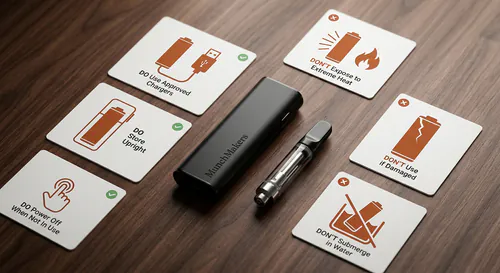
Charge to full, then unplug. Don't leave batteries charging unattended overnight, especially on flammable surfaces. This isn't overthinking it. It's a minor habit change that matters.
Some cheaper 510 thread batteries skip the protection circuitry to cut costs. This is the scenario where overcharging becomes genuinely dangerous. If you're buying a battery based purely on being the cheapest option available, you may be buying one without adequate protection.
Temperature is the biggest real-world risk
Leaving a vape pen in a hot car is probably the most common way people create a battery risk without knowing it. Interior car temperatures on a warm day can exceed 130°F. Lithium cells should not be stored above 113°F (45°C). The risk at high temperatures is that the electrolyte inside the cell degrades and, in severe cases, the cell vents gas.
If you're in a climate that gets hot in summer, don't leave your vape on the dashboard or in a glove compartment. Take it with you or store it somewhere it won't bake.
Cold temperatures are less dangerous but still affect performance. A very cold battery will appear dead but often recovers after warming to room temperature. Don't force-charge a battery that's been left outside in freezing temperatures until it's warmed up.
Pass-through charging
Pass-through charging means using the vape while it's plugged in and charging. Many devices support it technically, but it's not a great habit. You're drawing current from the cell at the same time it's being charged, which creates heat inside the battery. The occasional session while charging is fine. Using it exclusively this way will shorten battery life significantly and, with a low-quality cell, adds more stress than it should.
Use the right cable
510 batteries usually charge via USB-C or micro-USB. The cable matters more than people think. Cheap, poorly-made cables can deliver inconsistent power and in some cases have caused fires when connected to any lithium device.
Use cables from reputable manufacturers. The MFi-certified and USB-IF compliant versions aren't significantly more expensive. Don't use a frayed or damaged cable on any lithium device, including your vape.
What battery venting looks and smells like
If a lithium cell is failing, it may vent before it enters full thermal runaway. Venting means the cell releases gas through a relief mechanism. The signs are a sharp, chemical smell (often described as nail polish remover or burning plastic), heat you can feel through the device, and sometimes a slight hissing sound.
If your vape pen gets unusually hot during normal use, smells chemical without any obvious source, or the battery appears swollen, stop using it immediately. Put it somewhere non-flammable (a metal container, outside) and let it sit before disposing of it at an electronics recycling facility. Don't put a damaged lithium cell in the trash.
Physical damage matters more than you think
Dropping a vape pen occasionally is fine. These devices are built for it. But dropping a battery hard onto concrete repeatedly, bending it, puncturing it, or submerging it in water creates internal damage that can compromise the cell in ways that aren't visible externally. If your battery has taken a serious impact and you notice any change in how it heats up or behaves, retire it.
TSA rules for flying with a 510 battery
Lithium batteries below 100Wh are permitted in carry-on bags but not checked luggage. The FAA bans lithium batteries in checked bags because ground crews can't manage a battery fire in the cargo hold. A standard vape pen battery is well under the 100Wh limit, so it flies carry-on legally. Check the rules for your destination as some countries have stricter policies on vaping devices at customs.
For more on flying with vape equipment, the TSA vape rules guide has the specifics.
Storage when you're not using it
If you're storing a battery for more than a few weeks, leaving it at full charge is actually worse than storing it at around 50-60% charge. This is the same advice given for phone and laptop batteries during long-term storage. A battery stored fully charged for months degrades faster than one stored at partial charge.
Keep it in a cool, dry location. Not in a car. Not in direct sunlight. A drawer at room temperature is fine.
None of this is complicated. The habits that prevent most battery problems are: charge it, unplug it, keep it out of extreme heat, don't use damaged cables, and don't buy the cheapest battery with no protection circuitry. That covers probably 95% of real-world risk with vape pens.