Small rolling trays: best mini tray options for travel, desks, and small spaces
Not everyone needs a tray the size of a cafeteria lunch tray. If you roll one or two at a time, work at a small desk, or want something that fits in a bag without taking up half the space, a small or mini tray does the job just as well as a large one. Sometimes better, because you're not reaching across empty tray real estate every time you pick up your lighter.
Here's what you actually need to know about small rolling trays, including which situations they suit and which ones they don't.
Standard tray sizes explained
Rolling trays come in four sizes that the industry has mostly standardized around, though measurements vary slightly by brand:
- Small: approximately 7 by 5 inches
- Medium: approximately 11 by 7 inches
- Large: approximately 14 by 10 inches
- XL: approximately 14 by 11 inches or larger
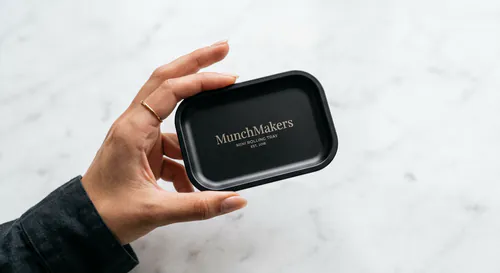
The small tray at 7 by 5 inches is genuinely compact. To give you a sense of scale, that's about the size of a hardcover novel laid flat. A medium tray is closer to an open magazine. A large tray is roughly a sheet of paper in landscape orientation.
For reference, a standard king-size rolling paper is about 4 inches long, so a small 7x5 tray gives you enough rolling length with a couple of inches of margin on each side. That's workable for most people.
Who should use a small tray
Small trays are genuinely the right choice in a few specific situations, not just a compromise.
Solo smokers who roll one at a time have no reason to own a large tray. You're not prepping multiple joints, you're not working with more than one paper at a time, and you don't need the surface area. A small tray keeps your workspace tight and intentional.
Desk use is another strong case. If you have a small or cluttered desk, a large rolling tray doesn't fit alongside a monitor, keyboard, and whatever else lives on your workspace. A 7x5 tray tucks into a corner without demanding space you don't have.
Travel is where small trays are non-negotiable. A large tray in a backpack is awkward, takes up real room, and feels more fragile than it is. A small metal tray slides into the main pocket of a bag, sits flat against a book or a laptop, and barely registers in terms of weight. If you're traveling with a joint case for transport and just need a surface for rolling on the road, small is the right answer.
What fits on a small tray and what doesn't
On a 7x5 tray you can comfortably fit: your papers, a small grinder, a lighter, and a few loose filter tips. That's a functional rolling setup.
What you can't comfortably fit: a full-size 4-piece grinder (the footprint is too wide and leaves no rolling room), a stash jar, a filter tip booklet lying open, and a dedicated poker or tamper. You have to pick.
The grinder issue is real. A grinder wider than about 2 inches starts eating into rolling room on a small tray. A 1.5-inch or 2-inch grinder is the maximum I'd recommend if you're working on a 7x5 surface. Mini grinders exist specifically for this use case and most of them grind just as well as full-size ones.
Stash storage has to move off the tray. Keep your herb in a jar nearby rather than on the tray surface. You take a pinch, put it on the tray, roll, done. The jar doesn't need to live on the tray.
Best materials for compact trays
Metal is my preference for small trays, specifically thin metal with rolled edges. It's light enough that a 7x5 version barely feels like anything in a bag, the surface is smooth and easy to clean, and the raised lip on rolled-edge trays keeps loose herb from sliding off even when the tray is on a slightly uneven surface.
Bamboo looks great and works fine for desk use. The natural texture is slightly rougher than metal, which some people like because it stops papers from sliding around while you roll. It's not ideal for travel because bamboo is less tolerant of being sat on or crammed against other objects in a bag.
Plastic and acrylic small trays are the lightest option but they show scratches over time and can develop static that pulls fine herb toward the surface. Fine for a bedroom setup, less ideal if you want something that ages well.
Making a small tray work efficiently
The main challenge with a small tray is real estate management. Every item on the tray needs to earn its spot. If something sits there all session and you never use it, it doesn't belong.
Keep the center of the tray clear while you're rolling. Grinder goes to the back corner, lighter to the front corner, papers to the side. The rolling zone is the middle, and you want it clear before you start. On a small tray, one misplaced object in the center forces you to move things around before you can work, which defeats the purpose.
A small container at the edge of the tray, like a bottle cap or a tiny ramekin, corrals filters without them rolling around or getting lost. This is more important on a small tray than on a large one because there's nowhere for a rolling filter to go except off the edge.
See our full selection of rolling trays in all sizes if you're figuring out which one to order. The rolling tray materials guide goes deeper on metal vs bamboo vs wood if you're weighing options. And if smell-proof storage is something you want paired with your tray setup, the smell-proof weed storage guide covers the containers that complement a compact setup well.