Torch lighter vs regular lighter: which one actually serves smokers better?
The honest answer is that it depends almost entirely on what you're smoking and where you're doing it. Torch lighters and soft-flame lighters solve different problems. Using the wrong one doesn't just make things inconvenient; it can actively ruin the experience you're going for. Let me walk through the real differences and who should carry each.
The basic physics
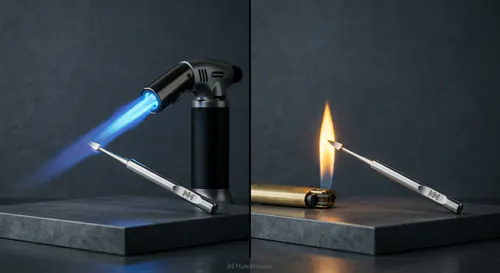
A regular soft-flame lighter, your standard BIC or Zippo, produces a yellow-orange flame by burning butane or naphtha in open air. The temperature at the tip of a soft flame sits around 1,800°F (980°C) under ideal conditions. Wind disrupts it easily, and the flame itself is relatively lazy. You can angle it, you can put it close to your material, but you can't force it to concentrate its heat.
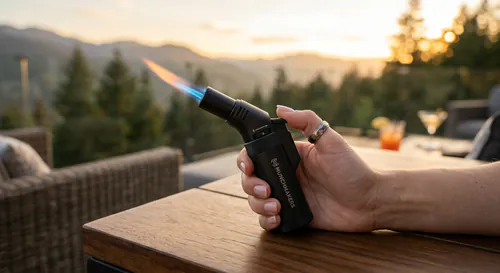
A torch lighter forces butane through a narrow nozzle under pressure, creating a jet of blue flame that burns at 2,500°F (1,370°C) or higher. That's not a small difference. A torch flame is directional, nearly windproof, and hot enough to sear materials that a soft flame would barely warm. The blue color isn't just aesthetic; it indicates complete combustion with minimal soot.
Which works for joints
For joints and cigarettes, a soft-flame lighter is the right tool. The gentle heat allows you to toast the tip evenly, and there's no risk of scorching one side of the paper or creating a harsh initial burn. A torch lighter applied to a joint will combust it instantly and unevenly. You'll get a hot, fast burn that some people describe as harsh, particularly at the start.
I've heard people argue that torch lighters work fine for joints if you hold them at a distance. This is technically true. But if you're holding a torch two inches away from a joint to avoid scorching it, you've essentially created a worse soft-flame lighter. Use the right tool.
Where torch lighters genuinely excel
Cigars are where torch lighters earn their reputation. Toasting the foot of a cigar evenly requires consistent, directional heat across a surface that can be 20mm or more in diameter for a larger ring gauge. A soft flame struggles to cover that area without the lighter flame touching the tobacco directly, which can impart taste from the naphtha or butane. A torch held at the right distance toasts the foot without contact, producing an even cherry and a cleaner initial draw.
For concentrate bowls and banger nails on dab rigs, a torch lighter isn't just preferable; it's more or less necessary. Quartz bangers need to reach 300-600°F (150-315°C) for proper dabbing temperatures, and a soft flame doesn't produce enough sustained heat to get there in a reasonable amount of time. Torch lighters designed for dabbing are typically butane-fueled with refillable tanks and adjustable flame size. Cigar torches work in a pinch but purpose-built dab torches usually have larger fuel capacity for longer heating sessions.
Pipe smokers are split on the question. Many prefer soft-flame lighters or pipe-specific lighters (with a horizontal or downward-angled flame) to avoid scorching the bowl rim. But a torch held well above the bowl works for some people without issue. Personal preference plays a bigger role with pipes than with any other format.
Wind resistance in real conditions
A standard soft-flame lighter at the beach or in a parking lot when there's any real wind is a frustrating exercise. You cup your hands, turn your back, and hope. Torch lighters genuinely solve this. The pressurized jet is resistant enough to light reliably in most outdoor conditions short of active wind gusts. For outdoor events, festivals, camping, or beach use, the case for carrying a torch lighter is straightforward.
Some soft-flame lighters (Zippos and certain windproof designs) handle moderate wind through chimney-style construction, but they still fail in stronger conditions. The torch wins for reliable outdoor use.
Fuel consumption
Torch lighters burn through fuel faster than soft-flame lighters, often significantly so. A standard BIC might last 2-3 weeks of daily joint smoking. A refillable torch with equivalent tank size might last 3-5 days of daily cigar lighting. This is why most serious torch lighter users buy in bulk butane and keep a refill can on hand. The higher consumption isn't a fatal flaw, just a management consideration.
Butane quality matters more for torch lighters than for soft-flame ones. Cheap butane contains impurities that clog the narrow nozzle of a torch. Triple-refined butane is worth the extra cost for any torch lighter you want to keep in good working order.
Safety differences
The higher temperature of a torch lighter means burns happen faster and more severely. They're not dangerous if used correctly, but the margin for error is smaller. Keep the flame pointed away from your face and hands when lighting, particularly during the initial ignition when the flame can be unpredictable. Never leave a torch running unattended; the temperature is high enough to ignite materials from a greater distance than you might expect.
Soft-flame lighters are more forgiving in close quarters and indoor use. For sessions at a coffee table or in a vehicle, they're safer by default because a moment of inattention is less likely to cause a problem.
What to carry
If you primarily smoke joints or cigarettes: a quality soft-flame lighter. A BIC if you want reliability and simplicity, a Clipper if you want refillability. If you smoke cigars, dab concentrates, or spend significant time outdoors: a torch lighter. If you do both, carry both. They cost almost nothing relative to the improvement in your actual experience. Many dedicated smokers have a soft-flame in one pocket and a small torch in the other or in their kit.
Browse our custom lighters for both formats, including metal lighter options that work in outdoor conditions. For a broader overview of lighter types, see our guide to windproof lighter designs.