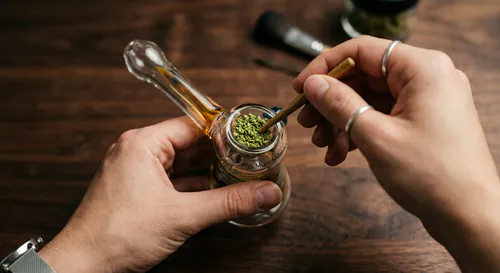
Packing a bowl right comes down to three moves: medium grind, fill loose (not packed), and tamp only the surface. Get those three right and every bowl burns evenly for 4–6 pulls before needing a re-light. Get them wrong and you get the standard problems — bowls that clog, canoe, hit too hard on the first pull, or burn straight through one corner.
The step-by-step below works for pipes, bongs, and bubblers. The mechanics are identical; the bowl size and screen options differ. If you're packing a joint or cone instead, see our cone joint guide — the techniques don't transfer.
Grind consistency for bowls
Medium grind. This is the most important variable and the one most people get wrong. Fine grind produces a dense, uniform pack that restricts airflow and pulls herb particles through the bowl piece and into your mouth. Coarse grind (breaking up by hand) leaves large chunks that create air gaps, so the bowl burns unevenly and one section burns out while another stays completely unlit.
A grinder set to 2-3 full rotations with average-density flower gives you the right result: pieces roughly 1-2mm in size, consistent texture, no powder. If your grinder's teeth are dull or you're overgrinding, you'll know because the result looks like green powder. That's too fine for a bowl.
Dry herb grinds better than fresh herb. If your flower is notably moist, it will clump and grind unevenly. You can break it up by hand first to get more consistent pieces before grinding.
Stems and how to handle them
Remove large stems before grinding. They don't contain the same cannabinoid concentration as the flower itself, they taste harsh when burned, and they disrupt the grind by creating uneven resistance in the grinder. Small thin stems that come through the grind are fine -- you can leave them in. Large woody stems from the base of a bud should come out before you grind.
If you're breaking up by hand instead of grinding, snap out all visible stems. Pack only the leaf material.
The small nug screen method
Before you add any ground herb, take a small loose piece of flower -- a small nug or a larger ground piece that didn't break down fully -- and place it at the bottom of the bowl to partially cover the hole. This acts as a natural screen. It's large enough not to pull through the hole when you draw, and it prevents the finer ground material on top from getting sucked through. You'll get an unobstructed draw without debris coming through into your mouth or down the pipe.
This technique is optional but genuinely helpful, especially with older pipes where the bowl hole has worn wider over time. It also helps when your grind came out finer than intended.
Packing technique: light at bottom, slightly denser at top
Load the ground herb in two layers. The first layer should sit loosely in the bottom half of the bowl. Don't compress it. Just let it settle. This loose base layer allows airflow through the bottom of the bowl so the entire surface lights rather than just the top layer burning while everything below stays unlit.
Fill to the rim or just slightly below with the second layer. Then use a finger to tamp the top surface down lightly -- just enough to create a flat, slightly denser top layer that will hold a flame and light evenly. Don't press hard. You're barely touching it. The goal is a level surface, not a compressed brick.
If you press too hard, the bowl will be tight and unpleasant to draw through. You'll be fighting the resistance on every hit and the bowl will burn unevenly because the air is taking whatever path it can find through the pack. Pack light. It's always better to pack slightly too loose than too tight.
Corner-lighting for best flavor
Don't light the center of the bowl. Touch the flame to one corner of the surface and draw slowly. This technique, called "cornering," lights a small section of the bowl rather than charring the entire surface at once. The unburned herb on the rest of the bowl remains green and fresh until it's your turn again. Every hit from a cornered bowl tastes better than one that's been full-surface torched on the first hit.
Cornering is especially important in group sessions. If you torch the entire bowl on your first hit, everyone else is getting ash. If you corner it, everyone gets fresh hits for two or three rounds.
Use a lighter held at an angle so the flame just catches the edge of the herb. A long lighter or a hemp wick gives you better angle control than a standard Bic.
Bowl size selection
Small bowls (0.1-0.2g capacity) are better for solo sessions. You load a manageable amount, smoke it in one or two hits, and the bowl is clean. Large bowls (0.3-0.5g+) are group-friendly. The downside of a large bowl for one person is that you're often letting it go cold between hits, which means you're repeatedly re-lighting and the flavor degrades with each relight.
Match bowl size to session size. Using a large bowl solo means wasted herb and more relights. Using a tiny bowl in a group means constant repacking.
How to know when the bowl is cashed
The bowl is cashed when you draw through it and the resistance is gone, the hit is thin and tasteless, and what you're seeing is pale gray ash rather than burning herb. You can stir the ash with a poker to see if there's any green material underneath, but generally once a bowl tastes like nothing but smoke and paper, it's done.
Some people press down on a half-cashed bowl to expose unburned material underneath. This works sometimes. The risk is that you compact the remaining material against the ash layer and restrict airflow further. Better to dump the ash, check for remaining herb, and repack if there's anything worth keeping.
Carb cap use on glass bowls
Most standard hand pipes have a carb hole on the side. You cover the carb with your thumb while drawing to build suction, then release it as you inhale to clear the chamber. This technique lets you fill the pipe with a concentrated cloud and then push it all through at once, which produces a more complete hit than drawing straight through without the carb.
If your pipe doesn't have a carb, you control the pull entirely by how hard you draw. Slow steady draws from non-carb pipes produce better flavor. Hard fast pulls cool the cherry down before the smoke reaches you.
Cleaning frequency
A pipe that hasn't been cleaned in weeks will pull resin taste through every hit, regardless of what you've packed in it. Clean your pipe at least every week if you're using it daily, or after every 3-4 sessions otherwise. Isopropyl alcohol and salt, shake and rinse. Five minutes and everything is fresh again. A clean pipe makes a noticeable difference to the first hit of a fresh bowl.
Keep a dedicated ashtray nearby to dump cashed bowls into cleanly. Tapping ash from a bowl directly onto a surface leaves residue and means you're constantly cleaning the table. The ashtray is there for a reason.
Use quality smoking accessories and your bowl-packing practice will improve faster than you think. The right grinder and a clean pipe eliminate most of the frustrating variables from the start.