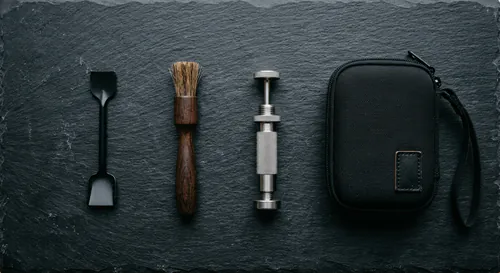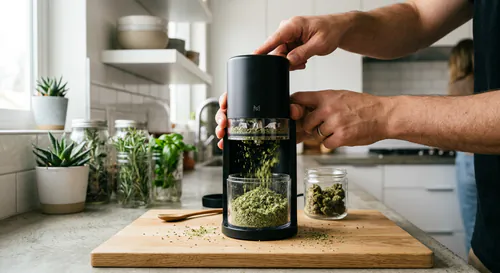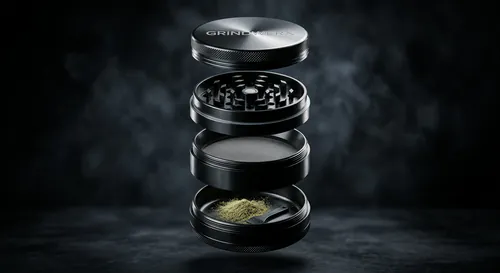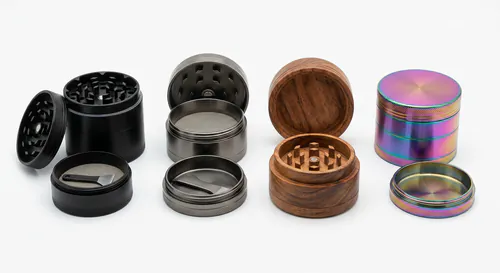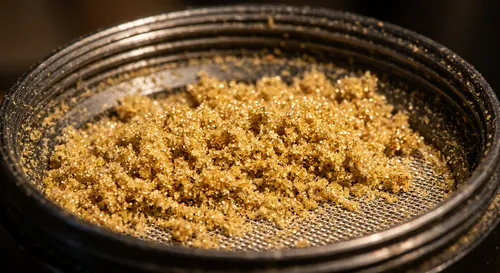
The best grinder for kief is a 4-piece with a 90–110-micron mesh screen and a deep enough kief chamber to let pollen settle without re-disturbing the grind above. Mesh size is what most buyers get wrong: too coarse and herb falls through; too fine and only the smallest particles make it. 90–110 microns is the sweet spot for cannabis trichomes.
Below: the screen specs that matter, the 4-piece designs worth buying for kief specifically, and the technique that doubles your collection rate per session. See our custom 4-piece grinders for spec sheets.
What kief actually is (and why it's worth keeping)
Trichomes are the resin glands that produce cannabinoids and terpenes. When they're dried and separated from the plant material, you're left with kief, a fine powder that's significantly more concentrated than flower. Depending on the strain and how well your grinder separates it, kief can be anywhere from 30% to 60% THC compared to flower that typically sits between 15% and 25%.
It builds up slowly. A moderate daily smoker might collect a gram of kief every two to three weeks. That's not a lot individually, but over a month you've got enough to do something useful with it.
How the screen mesh size changes everything
This is the part most people skip over when buying a grinder, and it's probably the most important factor in how much kief you actually end up with.
The screen between the grinding chamber and the kief catcher is measured in microns, the smaller the number, the finer the mesh. Most grinders ship with screens in the 150 to 220 micron range. That's a pretty wide window, and it matters.
A 150 micron screen is tight. Only the finest trichome heads pass through, so what you collect is purer and more potent, but the volume is lower. You'll wait longer to see a visible pile in the catcher.
A 200 to 220 micron screen lets more material through, including some plant matter. You'll collect kief faster, but it'll have a slightly greener color and a bit more chlorophyll mixed in. For most people, this is fine.
If you want cleaner kief and you're patient, go for a grinder with a 150 micron screen. If you want volume and you're not making pressed hash or anything that requires purity, 200 micron works well. The grinders with kief catchers we carry use food-grade stainless steel mesh, the actual micron count is worth asking about before you buy.
The freezer trick
Trichomes are brittle when cold. At room temperature they're slightly sticky and tend to cling to plant material instead of falling through the screen. Put your loaded grinder in the freezer for 20 to 30 minutes before grinding, and more of them will break off cleanly.
The method is simple. Load the grinder as you normally would. Stick it in the freezer. Wait. Then grind. You'll notice the kief catcher fills up faster over the next few sessions.
A few things worth knowing: don't do this with wet or fresh flower. The moisture will cause clumping issues. And don't leave a metal grinder in the freezer for more than 45 minutes, it's not going to ruin anything, but you'll get condensation when it warms back up, which you don't want near dry flower.
The coin trick
Drop a small coin into your grinding chamber. A nickel works well. As you rotate the grinder, the coin knocks trichomes loose from the teeth and chamber walls and pushes them through the screen.
This actually works. I was skeptical the first time I tried it, but the difference is noticeable, especially after a few sessions when there's residue built up on the inside walls that wouldn't otherwise fall through.
Clean the coin with isopropyl alcohol first. You don't want whatever's on a random coin mixing into your stash. A nickel-sized copper or stainless coin is better than silver if you can find one, but a regular nickel works fine in practice.
Combine the coin trick with the freezer method and you're getting close to the maximum possible yield from your flower. I've seen collection rates roughly double compared to grinding at room temperature without a coin.
Cleaning your grinder for better yield
A gunked-up grinder is a kief trap. Resin builds up on the screen over time, partially blocking the mesh and reducing how much trichome material passes through. If your grinder is more than a few months old and you haven't cleaned it, the screen is probably at least partially clogged.
Here's the cleaning process. Disassemble your grinder completely. Use a stiff brush, a toothbrush works, to knock loose debris off the screen. Hold the screen up to the light; you should be able to see through it clearly. If you can't, it needs more attention.
For a deeper clean, put the metal pieces (not the screen) in isopropyl alcohol, 91% or higher. Let them soak for 20 minutes, then scrub and rinse with warm water. For the screen specifically, use a soft brush with isopropyl and be gentle. Don't scrub hard enough to stretch or warp the mesh.
Let everything dry completely before reassembling. Any moisture that gets into the kief catcher will cause your collected kief to clump and stick to the walls, which is annoying to work with.
How often you clean depends on how much you grind. Heavy daily use probably means a full clean every 3 to 4 weeks. Casual use, every couple months is fine.
What to do with collected kief
Once you've got a pile going, you have a few genuinely good options.
The simplest is to top a bowl or joint. Sprinkle kief on top of packed flower and it burns evenly into the session. You'll feel the difference right away. This is probably what most people do with it, and it's a solid choice.
If you want to make something more versatile, press it into hash. The old-school method is to wrap your kief in parchment paper, fold it tightly, and use low heat and pressure to compress it. A hair straightener set around 150 to 170 degrees works well. Apply firm, steady pressure for about 5 to 10 seconds at a time. You end up with a small puck of hash that's easier to work with than loose powder and stores better.
You can also mix kief into butter or oil for edibles. It's less work than making a full cannabutter from flower because the potency is already concentrated. Use the same decarboxylation step, 240 degrees for 40 minutes in the oven, before adding it to fat.
Moon rocks are another option if you're feeling ambitious. Take a nug, coat it in concentrate or oil, then roll it in kief. Let it dry. The result burns slowly and hits hard. Not an everyday thing, but worth trying once.
Grinder features that actually affect kief collection
Beyond the screen micron size, a few other grinder characteristics change your yield.
Tooth count and shape matter. More teeth with a sharper edge creates finer, more uniform ground material. When flower is ground too coarsely, fewer trichomes break off and fall through. Diamond-cut teeth tend to outperform pegged teeth for this reason.
The depth of the grinding chamber affects how much plant contact happens before the ground material falls into the collection chamber. Shallower chambers mean less grinding time and coarser output. Deeper chambers give the grinder more passes to break material down.
Magnetic closures keep the lid from popping open mid-grind, which would scatter material. This sounds minor but it matters if you're doing the freezer method and the grinder is cold and slippery.
Size is worth thinking about too. A 63mm grinder will collect kief faster than a 40mm one simply because you can grind more flower per session. If kief collection is a priority, go larger.
Common mistakes that hurt your yield
Overpacking the grinding chamber is probably the most common one. When you stuff too much flower in, the material can't move freely, grinding is uneven, and less kief falls through. Fill the chamber about halfway and you'll get better results.
Grinding the same material twice doesn't help as much as people think. Once trichomes have broken off, there's nothing left to gain from a second pass. You'll just get finer plant material that might pass through the screen and contaminate your kief.
Not rotating the lid both directions is a missed opportunity. Most people only grind in one direction. Rotating back and forth, alternating directions every few rotations, creates more surface contact between the teeth and the flower. More contact means more trichomes knocked loose.
Letting kief sit in the catcher too long without collecting it is also a minor issue. Over time, exposure to air, humidity, and temperature changes degrades terpenes. Collect it every week or two and store it in a small glass jar with a tight lid, away from light and heat.
A note on grinder materials
Aluminum is the standard for mid-range grinders. It's lightweight, durable, and doesn't react with cannabis material. The main thing to watch for is anodized versus unanodized. Cheap unanodized aluminum can leave small particles in your grind over time. Anodized aluminum has a harder surface that resists this.
Titanium costs more and doesn't offer practical benefits for most users. Stainless steel is excellent but heavy. Acrylic grinders are inexpensive but tend to have worse teeth and screens, and they crack over time.
For collecting kief specifically, the screen material is more important than the body material. Stainless steel mesh holds its shape better than nylon over time, which means consistent micron sizing as the grinder ages.
If you want to dig deeper into what separates a genuinely useful grinder from a mediocre one, this guide on weed grinders with kief catchers covers the full breakdown. And if you're weighing specific options, this piece on choosing the best grinder for kief collection goes into more detail on what to actually look for.
The short version: get a grinder with a stainless steel screen in the 150 to 200 micron range, keep it clean, use the freezer method when you have time, and collect regularly. That's genuinely it. The kief builds up on its own from there.