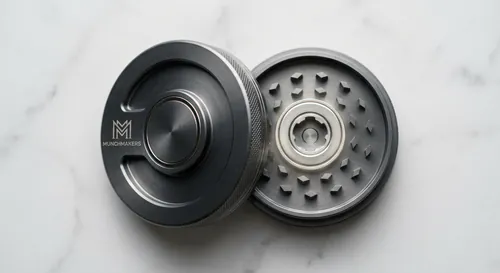
Most grinder buyers don't read a single word about the magnet when they're shopping. They look at tooth design, material, price, maybe chamber count. The magnet gets overlooked because it seems secondary -- it's just holding the lid on, right? But I'd argue the magnet is one of the single best indicators of overall grinder quality, and understanding why changes how you evaluate what you're buying.
What the magnet actually does
The lid of a grinder connects to the grinding chamber with threading on the outside, but it's held in alignment and kept closed by a magnet embedded in the center of the lid and a corresponding metal ring (or second magnet) in the top of the grinding chamber.
The magnet does three things. First, it pulls the lid into alignment when you place it on the grinder. This matters because metal-threaded grinding chambers can cross-thread when the lid goes on crooked -- and cross-threading is the fastest way to permanently damage a grinder. A strong magnet guides the lid to the correct position before you start rotating.
Second, it keeps the lid secured during grinding. When you're rotating the top half against the bottom half, the torque and your grip pressure create lateral forces that want to pull the lid away from center. The magnet counteracts this, keeping the grinding surfaces properly engaged.
Third, and most practically, it prevents accidental opening. When a grinder is in a bag, pocket, or being carried, the magnet is what keeps the lid from popping off and dumping your ground herb. A weak magnet means spillage. You've probably experienced this with a cheap grinder at some point.
Neodymium vs ferrite magnets
These are the two magnet types you'll encounter in grinders, and the difference matters.
Ferrite magnets (also called ceramic magnets) are the black or gray magnets common in cheap and mid-range grinders. They're inexpensive to produce and adequate for light use, but they have lower magnetic force per unit size. A ferrite magnet of a given diameter produces significantly less holding force than a neodymium magnet of the same size.
Neodymium magnets (also called rare-earth magnets) are the standard in quality grinders. For the same physical size, they produce 3 to 10 times the magnetic force of ferrite. In practical grinder terms, this means a snap-shut lid that feels secure with a satisfying click, stays closed reliably under all normal handling conditions, and guides alignment accurately even when the lid approaches slightly off-center.
When you feel a grinder lid that snaps firmly into place with a noticeable pull from several millimeters away, that's neodymium. When the lid sort of rests on the grinder and doesn't seem to want to stay particularly well, that's ferrite.
How magnet quality degrades over time
Magnets lose strength over time, and the process accelerates with certain conditions common in grinders. Heat is the main one. Exposing a grinder to high temperatures -- leaving it in a hot car, using it near open flame -- degrades magnetic strength faster than room temperature use. Ferrite magnets are more susceptible to heat demagnetization than neodymium.
Physical impacts can also cause partial demagnetization, especially in ferrite magnets. Dropping a grinder repeatedly on hard surfaces gradually reduces the alignment of magnetic domains in the ferrite material.
In a quality neodymium magnet under normal use conditions, you shouldn't notice meaningful degradation for years. In a cheap ferrite magnet under the same conditions, you might notice weaker lid snap within 12 to 18 months of regular use. In an abused ferrite magnet, the degradation can happen in months.
When the magnet weakens noticeably, you have a few options: live with a lid that feels loose (and risks spilling), look for replacement magnets sold for grinder repair (small neodymium discs available online for a dollar or two), or replace the grinder.
What a weak magnet costs you in practice
Beyond the annoyance of a loose lid, a weak magnet creates real functional problems.
Misalignment during grinding. When the lid isn't held firmly in position, the grinding surfaces can shift slightly during rotation, causing uneven tooth engagement and a less consistent grind. You won't notice this on a new grinder, but as the magnet weakens you may start seeing more coarse chunks in your ground material for no apparent reason.
Cross-threading risk. Without strong magnetic alignment, the lid goes on at whatever angle you place it. Cross-threading permanently damages the aluminum threading and can make the lid difficult to remove or cause metal particles to shed into your grinding chamber.
Spillage. The most obvious one. If you're using a magnetic grinder that can't hold the lid securely, carrying it in a pocket or bag means inevitable spillage. Paired with a rolling tray with magnetic lid, the consistency of a strong magnet in both pieces makes a real practical difference in a daily setup.
Specifying magnets for custom grinders
If you're ordering custom branded grinders, neodymium is the only magnet worth specifying. The cost difference at volume is small, and the quality difference in user experience is large enough that it reflects on whoever's name is on the grinder. A branded grinder with a weak, loose lid is an advertisement for a bad product. One that snaps shut cleanly and stays closed is one people remember positively.
For more context on how material quality relates to magnet performance and overall grinder durability, the materials comparison guide covers the relationship between aluminum grade, threading quality, and magnet strength as a combined system. And if you're interested in related accessories with magnetic closures, the magnetic rolling tray options guide covers the same quality considerations applied to tray lids.