Pre-roll vs joint: what's actually different and which is worth your money?
The words "pre-roll" and "joint" get used interchangeably all the time, but they're not the same thing. When a budtender hands you a pre-roll at a dispensary, the contents and the experience can be meaningfully different from what you'd roll at home with fresh flower. Understanding the difference helps you spend smarter and avoid disappointment.
What "pre-roll" actually means
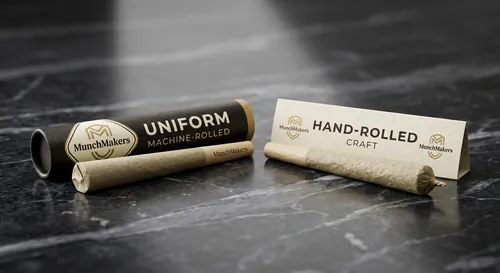
A pre-roll is simply a joint that someone else rolled before you bought it. The term became industry standard as legal cannabis dispensaries started selling machine-rolled joints at scale. You're buying convenience: no rolling needed, just light it.
A joint you roll yourself at home is technically also a pre-roll the moment it's done, but nobody calls it that. In practice, "pre-roll" refers to commercially produced products from a brand or dispensary, and "joint" refers to something rolled by hand.
The distinction matters more than it sounds because commercial pre-rolls and hand-rolled joints are often made with different materials, different fill quality, and different paper.
What goes inside commercial pre-rolls
This is where you need to pay attention. High-end pre-rolls from quality brands use whole ground flower, the same stuff you'd buy as an eighth. Cheap pre-rolls use shake and trim. Shake is the loose bits and small pieces that fall off buds during handling. Trim is leaf material removed during the manicuring process. Neither is flower. Both are significantly less potent per gram, which is why cheap pre-rolls often hit underwhelming compared to what you'd roll yourself.
Some brands are honest about this. Some aren't. The words "premium," "single source," or "whole flower" on the label are signals worth noticing. A $5 pre-roll from a budget brand almost certainly contains shake or a shake/trim blend. A $15 pre-roll from a craft producer is more likely to contain actual ground flower.
There's also the infused pre-roll category now: joints rolled with concentrate, hash, or kief added. These are more potent and more expensive, and they're in their own category from a quality standpoint.
Paper quality in commercial pre-rolls
Most dispensary pre-rolls use thin white paper that's serviceable but not exceptional. It rolls consistently in machines, burns reasonably well, and costs almost nothing per unit. Some brands use rice paper or hemp paper for a cleaner burn and less paper taste, but they're the minority.
When you roll your own joint with quality rolling papers, you get to choose the paper. Slow-burning hemp papers, ultra-thin rice papers, flavored papers if that's your thing. The paper makes a real difference to flavor, especially at the end of the joint where paper-to-herb ratio increases.
Cost analysis
The math generally favors rolling your own if you're smoking regularly. A gram of decent flower costs roughly $8-15 depending on your market. A pre-roll of that same gram will run $12-20 with the convenience markup. Over time that difference adds up.
The exception is when you factor in waste and skill. If you're still learning to roll and burning through papers with ruined joints, you're losing money on your learning curve. And a well-made pre-roll beats a badly rolled joint on every metric.
Pre-rolls also make economic sense for infrequent smokers who don't want to buy a grinder, a pack of papers, and a tin of tips for one or two uses per month.
How to evaluate pre-roll quality at a dispensary
Ask directly: is this whole flower or shake? Any budtender worth talking to will answer honestly. If they dodge the question, that tells you something.
Look at the paper. If you can see through it and the fill looks like actual ground bud with visible trichomes, that's a good sign. If it looks like a uniform pale green powder, it's shake or trim.
Feel the pre-roll. It should be firm but not rock-hard. A rock-hard pre-roll is packed too tight for proper airflow. A squishy pre-roll is loosely filled and will probably run on one side when lit.
Smell the sealed pre-roll if you can. Quality flower has a strong, complex terpene profile even through the paper and tube. If the smell is faint or generic, the flower is old or low-grade.
Storage matters more for pre-rolls than you'd think
Pre-rolls have a freshness window. Once rolled, the flower inside dries out faster than it would in a sealed jar because paper is permeable. A pre-roll that's been sitting in a plastic tube for two months will smoke harsher and taste worse than a fresh one.
If you buy pre-rolls in bulk, store them in an airtight container with a humidity pack at 58-62% RH. A pre-roll holder works well for single-unit protection when you're carrying one in a bag or pocket.
Hand-rolled joints don't have this problem in the same way because you typically roll them close to the time you smoke them, and the flower was stored properly beforehand.
Convenience vs control
Pre-rolls win on pure convenience. You're at a session, you want to smoke, you're not interested in the ritual. Done. Pre-roll in pocket, done.
Rolling your own wins on control. You choose the strain, the grind consistency, the filter style, the paper, the amount. You know exactly what went in. For people who actually enjoy the rolling process as part of the ritual, there's no reason to buy pre-rolls at all.
The honest answer is that both have their place. I keep a few quality pre-rolls for situations where rolling isn't practical, and I roll my own when I'm at home with time and good flower. The mistake is assuming all pre-rolls are the same, or that they're always inferior. The quality range in the commercial pre-roll market is genuinely wide. Do the homework on the brand before you assume the $8 pre-roll from the discount bin is worth it.
Check out our guide to filter tips if you're thinking about stepping up your hand-rolling game. The difference a proper crutch makes to a hand-rolled joint is bigger than most beginners expect.