Why ashtrays are worth thinking about as branding surfaces
Most dispensaries spend real money on packaging, signage, and digital ads, then hand customers a generic glass ashtray at the register or in the lounge. That's a missed opportunity sitting right on the surface level.
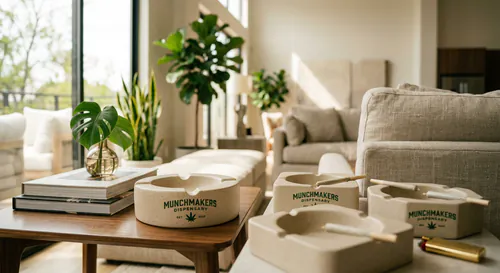
An ashtray is one of the few accessories that stays out in the open. It doesn't go in a drawer when the session is over. It sits on a coffee table, a desk, a bar, or a dispensary counter and stays there. If your logo is on it, your logo is visible every day to everyone who walks into that space. That kind of persistent exposure is hard to buy through paid media.
The category has also moved well past generic ceramic restaurant-style trays. Custom ashtrays now come in a range of materials and print qualities that can look genuinely intentional, not like an afterthought. Getting the details right matters, though, so let's go through what you're actually choosing between.
Materials and what each one is actually good for
The material question affects durability, how well the piece accepts branding, price per unit, and what kind of aesthetic message it sends. These are not interchangeable.
Ceramic is the traditional choice and still one of the best for branding. It accepts full-color glaze printing and decal transfer with excellent color fidelity. A well-made ceramic ashtray feels substantial, cleans easily, and is heat resistant enough that it won't scorch or stain under normal smoking conditions. The main tradeoff is fragility in transit and in high-traffic settings. For a dispensary lounge, a retail display, or a gift, ceramic works very well. For outdoor events or a scenario where the piece might get knocked around, it's not the best call.
Silicone has become a serious contender, especially for casual and outdoor use. It's nearly indestructible, dishwasher safe, and lightweight. The heat resistance on quality silicone is genuinely good -- it won't melt from a dropped coal or a resting joint. For branding, you're typically working with molded color and pad printing rather than fine-detail graphics, so logos need to be clean and simple. It reads as functional rather than premium, which is fine if that's the message you want to send.
Metal ashtrays, usually stainless steel or aluminum, occupy the middle ground. They're durable, easy to clean, and accept laser engraving cleanly. The engraved look on brushed stainless is genuinely sharp -- it reads as elevated without being ostentatious. Unit costs are moderate, and they hold up well in retail environments. The main limitation is heat transfer: metal conducts heat efficiently, which some users prefer and others don't.
Glass is the choice when aesthetics are the priority. Clear or frosted glass with etched branding or color fills looks expensive because it usually is. Glass ashtrays are best suited for premium product launches, gift sets, or high-end lounge environments where the piece is meant to make an impression. They're harder to customize at scale because the processes involved (sandblasting, etching, glaze painting) are more labor-intensive than printing on ceramic or metal.
Printing and engraving methods compared
Once you've chosen a material, the branding method determines how your logo actually ends up on the product.
Sublimation printing on ceramic produces vivid, photographic-quality color that goes deep into the surface rather than sitting on top of it. It's durable and looks very clean. The limitation is that it requires a specific type of coated ceramic, so not every manufacturer offers it. If color accuracy matters to you and you're printing on ceramic, ask specifically about sublimation versus decal transfer.
Decal transfer (also called under-glaze printing) is the standard for ceramic production. A printed decal is applied and then fired at high temperature, fusing it to the glaze. Done well, it's durable and colorfast. Done poorly, edges can lift over time with repeated washing. Ask to see a durability sample if you're ordering more than a few hundred units.
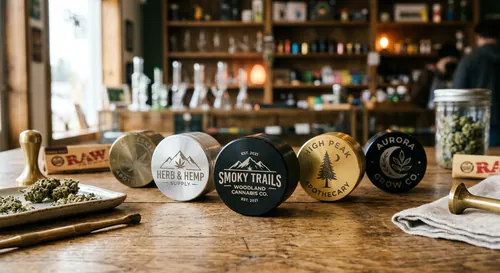
Laser engraving on metal produces a permanent, ink-free mark that won't fade or peel. It's the highest-durability option available and reads as premium. The trade-off is single-color output -- the contrast comes from the difference between the engraved surface and the base material, not from ink. Logos that depend on color need to be reformatted as clean silhouettes or line art.
Pad printing is cost-effective and widely available. It works on ceramic, metal, and silicone. Color matching is generally accurate, and it handles medium-detail logos well. For fine lines or small text, quality varies by manufacturer. It's the right choice when you need a large quantity at a reasonable per-unit cost and don't need the permanence of engraving.
Use cases for dispensaries and cannabis businesses
Dispensary lounges are the most straightforward application. If you're operating a consumption space, every surface is a branding touchpoint. A ceramic ashtray with your logo, your dispensary's name, and a clean design sitting on every table is visible to every customer who comes in. It also communicates something about the experience you're creating -- cheap or absent ashtrays read as careless, while quality ones say the details matter to you.
Gift-with-purchase programs work well with ashtrays because the form factor is universally useful. A customer who spends over a certain amount gets a branded ashtray in the bag. They take it home, it goes on the coffee table, and it stays there. You're not buying ad space, you're leaving an object in their home that they use.
Events and pop-ups are another strong use case. Cannabis brand activations, 420 events, and dispensary anniversary parties are opportunities to hand out or display custom pieces that reinforce the brand. For events, silicone or aluminum makes more sense than ceramic because they travel without breaking and can be passed around freely.
Staff gifts and internal branding have real value too, especially for multi-location operations. A quality custom ashtray as part of a staff welcome kit or seasonal gift communicates that the brand is thoughtful. It's a small thing that gets noticed.
What actually makes a custom ashtray worth ordering
The most common mistake is choosing on price alone. A cheap ceramic ashtray with a logo stamped on it in a process that shows banding or color drift is worse for your brand than no ashtray at all. Customers notice quality, and they associate the quality of a giveaway item with the quality of the brand behind it.
Rest notches are a functional detail that separates a smoking ashtray from a decorative one. You want at least two notches, ideally three or four, at the right depth to hold a joint or cigarette without it rolling off. It sounds basic, but there are branded ashtrays out there with notches too shallow to do the job properly.
Size matters more than most people plan for. A 3-inch ashtray looks fine in photos but feels small in use. A 4-to-5-inch diameter is the practical minimum for anything meant for regular use. For a lounge setting, 5 to 6 inches reads as substantial and provides enough surface area that the branding is actually visible from a few feet away.
Depth is also worth thinking about. A shallow tray fills up fast and looks messy quickly. A deeper bowl holds more ash and debris before it needs to be emptied, which matters in a busy lounge.
Designing your artwork for the format
Ashtray branding surfaces are usually curved, relatively small, and viewed from close range and from a distance. That combination means your design needs to work at multiple scales.
The center of the tray is the primary branding real estate. A logo mark (the symbol alone, or a simple lockup) tends to work better than a full brand wordmark with tagline when you're working on a circular ceramic surface. The logo needs to read clearly when the tray is in use and partially covered with ash -- which means the version with the highest contrast and the simplest forms.
Avoid thin lines under 0.5mm for printing processes. For engraving, avoid extremely fine serif type at small sizes -- it either fills in or disappears. If your brand identity uses a complex typeface, work with your manufacturer on a simplified version for this format.
Color strategy for ceramic: glazes can shift slightly in the kiln. True black is reliable. Custom colors should be matched using a PMS reference and verified against a physical sample before approving a full run. Blues and greens tend to be stable, while certain reds and oranges can be more variable depending on the ceramic body and glaze chemistry.
Ordering in bulk: what to expect on pricing and minimums
Custom ceramic ashtrays typically have minimums in the 50 to 100 unit range for decal transfer printing, and the price per unit drops significantly as you move from 100 to 500 units. Laser-engraved metal tends to have lower MOQs, sometimes starting at 25 to 50 units, because there are fewer setup costs involved.
Lead times from production to delivery are usually 3 to 5 weeks for standard orders, longer if you're requesting a physical sample approval before production. For events with a fixed date, plan accordingly and add a week of buffer.
Packaging is worth considering at the order stage. Ashtrays shipped individually in protective foam or tissue paper land better as gifts than ones shipped loose in a box. Some manufacturers offer window boxes or kraft boxes with minimal additional cost per unit. If you're planning to use these as gift-with-purchase items or event giveaways, the packaging presentation is part of the impression.
For a broader look at what's available in the full range of ashtray styles and materials, the guide to different types of ashtrays covers the category well, and there's a more in-depth buyer's perspective at the ultimate buyer's guide to weed ashtrays. If you're thinking about the full branded accessory ecosystem rather than just the ashtray in isolation, MunchMakers custom accessories covers the complete range of what can be matched and coordinated across a product line.