Why businesses use grinders as branded merchandise
Grinders are one of those products that people actually keep. Unlike a branded pen that ends up in a drawer or a tote bag that gets tossed, a well-made grinder sits on a desk, travels in a pocket, and gets used multiple times a day. That kind of repeat exposure is worth something to a brand.
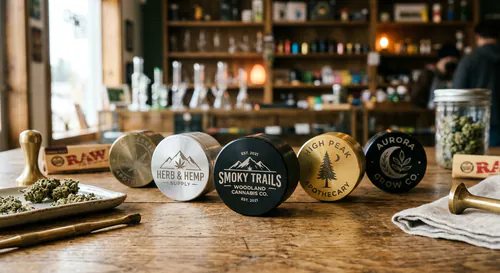
Dispensaries figured this out early. Give a customer a quality grinder with your logo on it, and they're looking at your branding every single time they use it. That's advertising you don't have to buy placement for. Event organizers, cannabis brands launching new product lines, and companies looking for cannabis-adjacent merch have all caught on.
The market for custom grinders has grown fast, and the quality of what's available now is genuinely impressive compared to what existed even five years ago.
Material options and what they actually mean
The material your grinder is made from affects everything: weight, durability, how well it accepts different printing methods, and price point.
Aluminum is the standard. It's lightweight, machines cleanly, and holds a logo well whether you're laser engraving or pad printing. Most mid-range custom grinders are aluminum. The anodized finish gives you a range of color options, and anodizing also makes the surface harder and more resistant to wear. If you're ordering for a dispensary or event giveaway and want something that looks and feels substantial without a high unit cost, aluminum is your answer.
Zinc alloy is heavier and has a slightly different feel in the hand, almost closer to stainless steel. It's used in grinders that are meant to feel premium without the price jump that comes with actual high-end metals. The weight reads as quality to most people. Printing methods work similarly to aluminum, though the surface texture can vary by manufacturer.
Titanium is in a different category entirely. It's harder, lighter than you'd expect for how strong it is, and it holds an edge on the teeth longer than aluminum. If you want to read more about how titanium compares to aluminum on a functional level, there's a full breakdown at titanium vs. aluminum grinders. For branding purposes, titanium communicates luxury. The unit cost is higher, so it makes more sense for premium product launches or gift-with-purchase offers than for large-scale event giveaways.
Customization methods explained
There are three main ways to put your brand on a grinder, and the right choice depends on your budget, order size, and what the final product needs to look like.
Laser engraving removes material from the surface to create a permanent mark. There's no ink, no coating, nothing to peel or fade. The logo becomes part of the metal. The result is clean, sharp, and reads as premium. It's the best method if you want something that will still look good after two years of daily use. The limitation is that you're working in one color, so logos that depend on specific colors need to be simplified or rethought for this format.
UV printing puts ink directly onto the surface using ultraviolet light to cure it almost instantly. You get full color, and the detail level is very high. It's better suited for designs with gradients, photos, or multi-color logos. Durability is good but not quite at the level of engraving. For event giveaways or seasonal merch where longevity is less of a concern, UV printing gives you the most visual flexibility.
Pad printing transfers ink from a silicone pad onto a curved or irregular surface. It's the oldest of the three methods and still widely used because it's reliable and cost-effective at scale. If you've handled a branded lighter or small promotional item before, there's a good chance it was pad printed. The color matching is generally accurate, though highly detailed designs can lose some crispness.
MOQ: what to expect and how to plan
Minimum order quantities vary significantly depending on the manufacturer and the customization method. Laser engraving typically has lower MOQs because it doesn't require setup costs the way printing does. You can often get started with 50 to 100 units. Pad printing and UV printing have setup fees that make smaller runs more expensive per unit, so manufacturers usually set minimums at 100 to 500 units to make the economics work.
For dispensaries doing a soft launch or a pop-up event, starting with 100 to 150 units is a reasonable test. You learn how customers respond to the product and whether it's worth scaling up. For a larger dispensary group or a brand launch with distribution, orders of 500 to 1,000 units are common and usually unlock better per-unit pricing.
Lead times are something people underestimate. Custom grinders from overseas manufacturers typically take 4 to 6 weeks once the order is confirmed and artwork is approved. If you need them for a specific event, plan backwards from that date and add a buffer. Rushing production is expensive and stressful, and it usually shows in the quality.
Use cases worth considering
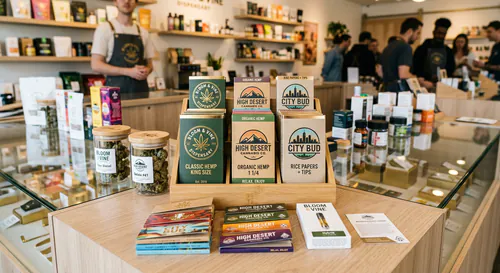
Dispensaries are the obvious starting point. A branded grinder in a welcome kit or as a gift with a first purchase sets a tone. It says the dispensary cares about the experience, not just the transaction. Customers who get a quality accessory with their first order are more likely to come back.
Cannabis brands doing merch drops use grinders as a core item because they're functional and have mass appeal. A t-shirt appeals to some people, a hat to others. A good grinder is useful to almost everyone in the market. It also photographs well, which matters for social media.
Corporate events and trade shows in cannabis-adjacent industries have embraced branded accessories as swag that people actually want. A grinder from a cannabis tech company or a packaging supplier is a lot more memorable than a USB drive or a branded water bottle.
Private events are another angle that doesn't get talked about as much. A wedding where the couple is cannabis-friendly, a birthday milestone, a retirement party for someone in the industry. Custom grinders with a date and a name or short message on them work well as party favors that feel personal and useful.
Pairing grinders with other custom accessories
A grinder alone is a solid giveaway. A coordinated set of accessories is something people talk about.
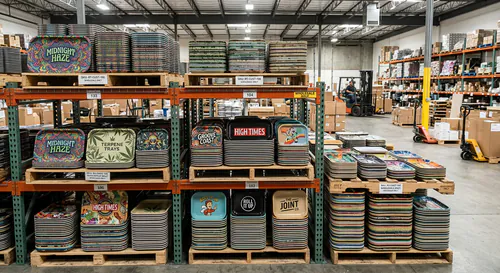
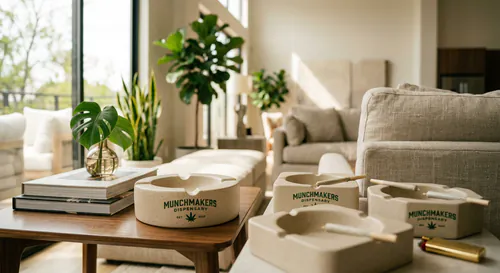
The most natural pairing is a grinder and rolling tray with matching branding. The grinder goes over the tray, the session happens on branded real estate, and the customer's whole setup carries your logo. Custom rolling trays are available in the same range of print methods, so matching the finish and artwork across both products is very doable.
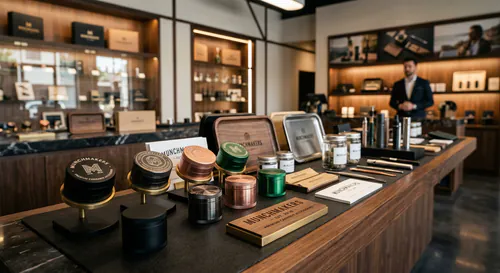
For dispensaries building a starter kit, think about what actually gets used together: a grinder, a tray, and maybe a storage jar or a lighter. Packaging them together in a branded box elevates the perceived value without a huge increase in cost. The unboxing moment matters to customers, and a coherent set does more for brand perception than individual items thrown in a bag.
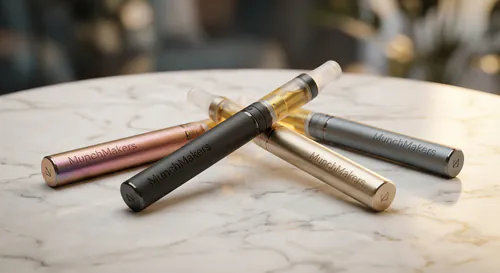
If you're at the stage of planning a full branded merchandise line, it's worth mapping out the workflow. What does a session look like start to finish? Grind, roll or pack, smoke. There's an accessory at each stage, and each one is an opportunity. MunchMakers custom smoke accessories covers the full range if you want to see what a complete branded lineup looks like.
Getting the artwork right
This is where a lot of orders go sideways. A logo that looks great on a website or business card doesn't automatically translate to a 2-inch circle on a grinder lid.
Simplify. Fine lines under 0.5mm tend to disappear or bleed in most printing processes. Text smaller than 8pt is usually illegible. If your logo has a detailed illustration or small secondary text, you'll need a simplified version for the grinder.
Vector files are standard for a reason. If you only have a JPG or PNG of your logo, ask your designer for the original vector file before you place the order. Manufacturers will often work with high-resolution raster files, but vector gives the cleanest output.
For laser engraving, contrast matters differently. The engraved area will be a different shade than the base material, so designs that rely on color contrast need to be rethought in terms of shape and line weight.
Most reputable manufacturers will send a digital proof before production. Review it on a screen that's color-calibrated if you care about color accuracy, and if possible, request a physical sample for orders above 250 units. The cost of a sample is almost always worth it.
What to ask before you order
The grinder teeth quality is something that gets overlooked when people are focused on branding. A grinder that grinds unevenly or jams after a few uses reflects badly on whoever put their logo on it. Ask about tooth design, the number of pieces (2-piece, 4-piece with kief catcher), and whether there's a quality control process. For more detail on what separates a good grind from a frustrating one, the guide to coarse weed grinders covers the mechanics well.
Also ask about the magnet. The lid magnet on a cheap grinder is usually the first thing to go. A strong neodymium magnet should hold the lid securely through normal use. It's a small detail that users notice.
Anodizing quality on aluminum grinders varies. The color should be consistent across a batch, and the coating should be uniform with no thin spots that will wear through quickly. Request photos of the actual production line samples if you're ordering a large quantity.
Custom grinders are one of the more durable and practical branded items you can put your name on. Done well, they last years and keep your brand in circulation the whole time.