Why dispensaries are buying trays in bulk
Rolling trays used to be an afterthought in dispensary retail. Now they're a line item in quarterly marketing budgets. The shift happened because enough dispensary owners ran the numbers and figured out that a branded tray sitting on a regular customer's coffee table generates more impressions per dollar than most paid channels.
That math works if the tray is good enough to keep. Cheap trays with faded prints end up in the trash. Quality trays with sharp branding get used and displayed. The difference between those two outcomes comes down to decisions made at the wholesale buying stage, before you've committed a dollar to production.
This guide is written for dispensary owners and buyers who are sourcing wholesale rolling trays for the first time, or who have ordered before and want to do it better.
How wholesale pricing actually works
Rolling tray wholesale pricing is driven by three variables: quantity, customization method, and material. Understanding how those interact helps you know whether a quote is reasonable or inflated.
Blank metal trays with no customization can be sourced for $1.50 to $3.50 per unit at quantities of 100 to 500. That's the floor. Once you add custom printing, you're adding a setup cost that gets amortized across the order size, plus a per-unit cost for the printing itself.
At 100 units with sublimation printing on a standard medium metal tray, you're typically looking at $5 to $9 per unit all-in. At 250 units, that drops to $4 to $6. At 500 units, you're usually in the $3 to $5 range. These are general figures and actual quotes vary, but they give you a baseline for evaluating proposals.
Screen printing is more economical at high volumes but has steeper setup costs. At 500 units, the per-unit cost for screen-printed trays is often lower than sublimation, but the setup fee for screens (usually $50 to $150 per color) makes small runs expensive. If you're ordering 500 or more and your design has two or three defined colors, ask for a screen print quote alongside the sublimation quote and compare total costs.
Trays with magnetic lids cost more, generally 30 to 60 percent more per unit than open trays. For a retail product you're selling rather than giving away, that premium is usually justified. For a free giveaway with a first purchase, it probably isn't.
Volume discounts: when they kick in and by how much
Most suppliers tier their pricing at 100, 250, 500, and 1,000 units. The biggest per-unit drop usually happens between 100 and 250 units, then the curve flattens. Going from 250 to 500 typically saves you another $0.50 to $1 per unit. Going from 500 to 1,000 might save another $0.25 to $0.50.
For a single-location dispensary, 250 to 500 units is usually the sweet spot where you get meaningful pricing without overcommitting to inventory. For a multi-location group or a brand doing a product launch, 500 to 1,000 makes sense.
Don't let a supplier push you into 1,000 units on your first order by quoting the per-unit price without context. Factor in warehousing, the risk of design changes, and cash flow. A smaller first order at slightly higher per-unit cost is almost always the right call when you're testing a new product.
Choosing the right tray for your market
Not all dispensary customers are the same, and the tray you choose should reflect who you're trying to reach.
A value-focused dispensary doing high volume with frequent promotions should lean toward standard metal trays in medium or large at aggressive pricing. The product needs to be good enough to keep but the economics have to work for frequent distribution. Sublimation printing at 250 to 500 units hits that balance.
A premium dispensary with a curated aesthetic might want to spend more per unit on a bamboo or wood tray with laser engraving. The unit cost is higher, but so is the perceived value, and that fits the positioning. A customer who spent $80 on an eighth expects a different giveaway than a customer who shopped on price.
A cannabis brand launching a product line wants a tray that photographs well and looks good in unboxing content. Dark backgrounds with clean logo treatments work well for that use case. The tray is partly a product and partly a piece of content strategy.
If you're still figuring out what customization options make sense for your situation, the full breakdown in the custom rolling tray guide covers materials, print methods, and design decisions in much more depth.
Branding strategies that actually work
The most common branding mistake in wholesale tray orders is treating the tray like a business card. A logo on a plain background is not a product people want to display. It's a proof that someone ordered trays.
Full bleed design, where artwork covers the entire tray surface, performs better than centered logos on a plain background in almost every context. It shows that someone thought about the design, and it looks like a finished product rather than a marketing asset.
Seasonal or campaign-specific designs work well for dispensaries that order regularly. Instead of printing 500 trays with a generic logo to distribute over 18 months, print 150 trays with a summer design, 150 with a fall harvest theme, and 150 with a holiday edition. The per-unit cost is slightly higher but the customer excitement around each limited run is worth it. People who have the spring tray want the summer tray.
For multi-location dispensary groups, consider whether you want consistent branding across all locations or location-specific designs. Consistent branding builds the parent brand and is simpler to manage. Location-specific designs create local attachment and can be used for store-specific promotions. There's no universal right answer, but it's worth deciding intentionally rather than defaulting to whatever's easiest.
Packaging options and why they matter
How a tray arrives in the customer's hands affects how they perceive it. A tray dropped loose in a paper bag reads differently than a tray in a sleeve or a branded box, even if the tray itself is identical.
Polybag with header card is the most economical packaging option. It protects the tray during distribution and the header card gives you space for a brand message or QR code. It reads as functional but not premium.
A sleeve or wrap around the tray is a step up. It keeps the tray clean, gives you a full-color design surface, and photographs well. For point-of-sale display or for a product you're putting in a welcome kit, a sleeved tray looks intentional.
A rigid box is the premium option and makes sense if the tray is a standalone retail product or a gift-with-purchase for a high-ticket transaction. The box adds $1 to $3 per unit depending on quality, which is usually worth it when the tray itself costs $7 to $10.
Comparing tray options to other wholesale accessories
Rolling trays compete for the same wholesale budget as grinders, lighters, and rolling papers. It's worth understanding how they compare on the metrics that matter to a dispensary.
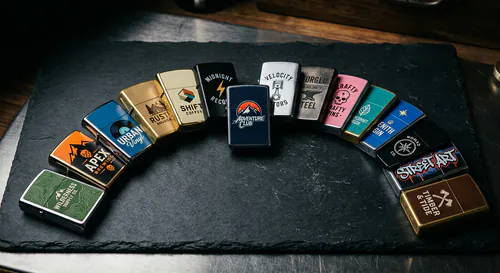
Lighters have the lowest per-unit cost and the highest giveaway volume potential. But a lighter gets used up and disposed of. The branding goes with it. A tray stays.
Grinders have longer retention than lighters and function as daily-use items, which means repeated brand exposure. The per-unit cost is higher than trays at similar quantities. For a dispensary choosing between trays and grinders for a campaign, consider that grinders live in pockets and bags while trays live on surfaces in plain view. Different visibility patterns.
Rolling papers are the most consumable of the three. They get used, finished, and replaced. Good for building a consumable repurchase habit but the individual branding impression lifespan is short. If you want to see how trays and grinders compare in a wholesale context, the wholesale grinders guide covers that side of the decision.
Trays occupy a unique position as the only large-format, permanent-display item in a typical dispensary giveaway program. That's a specific value that the other categories don't replicate.
Fulfillment and logistics considerations
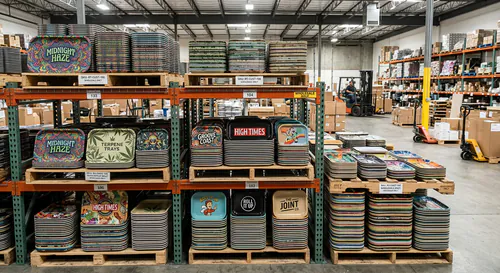
Trays are flat and stack well, which makes them storage-efficient. A pallet of 500 medium trays takes up less space than you might expect. That said, they're not the most shipping-friendly item per unit because they're not compact relative to their weight.
For multi-location groups, think about whether you want all inventory shipped to a central warehouse and distributed internally, or shipped directly to each location. Direct-to-location shipping simplifies logistics but you lose visibility over inventory levels. Central warehousing gives you control but requires someone to manage the distribution.
If you're ordering from overseas manufacturers, which is where most metal rolling tray production happens, build in time for customs and inland freight. A production lead time of 4 weeks can become 6 weeks by the time product clears the port and reaches your facility. For campaign-critical inventory, that buffer is not optional.
Some domestic suppliers can produce and deliver in 2 to 3 weeks but the per-unit cost is higher. For reorders of an established design, overseas manufacturing works fine. For a first order with a tight deadline, paying the premium for domestic production is worth it.
What to ask before placing a wholesale order
A few questions that consistently separate good wholesale suppliers from frustrating ones:
Ask for samples of previously produced trays, not just mockups. A mockup shows how a design will look. An actual sample shows you how the print quality holds up, whether the edges are clean, how the surface feels, and whether the tray lies flat without warping.
Ask about their quality control process. What percentage of units get inspected? What happens if defects come through? Reputable suppliers have a clear answer. Suppliers who deflect or give vague answers about "high standards" are often the ones whose quality varies batch to batch.
Ask about reorder lead times. Once you have an approved template on file, how quickly can they turn around a reorder? That number matters a lot for dispensaries that want to replenish stock quickly during a campaign.
Ask about minimum for design changes. If you want to update the artwork between orders, is there a new setup fee? Does the MOQ reset? Some suppliers treat design changes as a new order. Others will reprint at the original pricing if the core product spec stays the same.
Wholesale rolling trays are a repeatable, scalable part of a dispensary's branded accessory program. The economics work, the product has genuine utility, and customers hold onto them. Get the spec, the design, and the supplier relationship right, and you'll have a wholesale line item that earns its place in the budget every quarter.