Titanium vs Aluminum Grinders: Which is Worth the Upgrade?
The material your grinder is made from affects how it feels in your hand, how long it lasts, what you'll pay, and whether you can put your logo on it. Titanium and aluminum are the two most common premium metal options — and the differences between them are real, but not always in the ways people expect.
Short answer: for most people, aluminum is the better choice. Here's why.
Aluminum Grinders
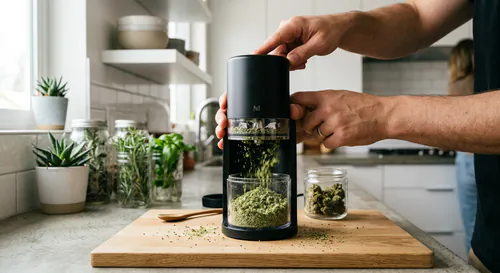
Aluminum — specifically aircraft-grade 6061 alloy — hits a useful middle ground between strength and machinability. It has a hardness of around 60 HRB (Rockwell B scale), which is more than enough for daily grinding use. A typical 2.5-inch four-piece aluminum grinder weighs about 90–120 grams, making it noticeably lighter than steel alternatives while still feeling solid.
Because aluminum machines cleanly, manufacturers can cut sharper, more precise teeth than you'd get from softer zinc alloys. The result is a consistent grind — fine enough for papers, coarse enough for bowls, depending on tooth geometry. Aluminum also holds anodized finishes well, which is why most grinders you see in black, blue, or red are aluminum underneath.
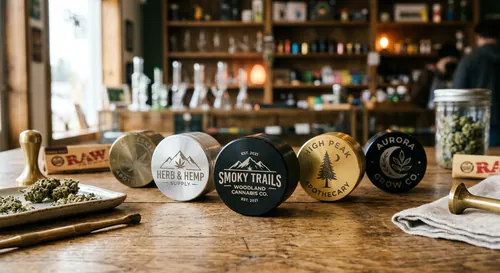
The bigger practical advantage is customization. Aluminum takes laser engraving and UV printing better than any other common grinder material. The surface is flat enough and thermally stable enough for fine detail work — logos, artwork, text — without the edge distortion you get on harder materials. If you're ordering custom grinders for a dispensary, brand, or event, aluminum is what makes that possible at a reasonable price.
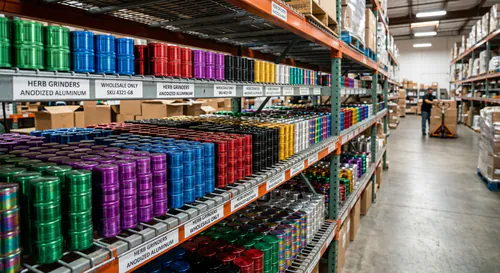
Cost is the other factor. A quality aluminum grinder runs $20–$50 retail. custom branded products runs higher, but the per-unit economics are manageable even at mid-range quantities.
Best for: daily use, custom branding, price-conscious buyers, anyone who values a lightweight carry.
Example: MunchMakers Custom 4-Piece Aluminum Grinder
Titanium Grinders
Titanium (grade 2 or grade 5) is harder and more corrosion-resistant than aluminum. Grade 5 titanium (Ti-6Al-4V) has a hardness around 36 HRC — significantly higher than aluminum's 60 HRB. It won't scratch from keys in a pocket, and it's essentially immune to oxidation.
The weight is closer to aluminum than most people expect. Titanium is about 60% the density of steel but roughly 1.7x the density of aluminum, so a titanium grinder built to the same dimensions will be noticeably heavier. That said, manufacturers often use thinner walls to compensate, which can bring weights within 20–30 grams of comparable aluminum models.
Where titanium runs into trouble is machinability. It's much harder to cut than aluminum, which drives up manufacturing cost and limits design options. Tight tolerances are harder to hold, so some titanium grinders have looser threading than well-made aluminum ones. You're also paying a significant premium — titanium grinders typically start at $60–$80 and go well above $100 for quality pieces.
Customization is limited. The material doesn't take laser engraving as cleanly as aluminum, and UV printing on titanium requires specific surface prep. If branding matters to you, titanium is the wrong choice.
Best for: buyers who want maximum scratch resistance and don't care about customization or price.
See also: MunchMakers Titan Grinder (stainless steel — similar durability profile to titanium at a better price point)
Head-to-Head Comparison
| Feature | Aluminum (6061 Aircraft-Grade) | Titanium (Grade 5) | Advantage |
|---|---|---|---|
| Hardness | ~60 HRB | ~36 HRC (much harder) | Titanium |
| Weight (typical 2.5") | 90–120g | 110–145g (varies by construction) | Aluminum |
| Grind performance | Excellent with sharp teeth | Excellent with sharp teeth | Tie — tooth design matters more than material |
| Scratch resistance | Good (anodized finish helps) | Excellent | Titanium |
| Customization | Excellent — laser engraving and UV printing | Limited and expensive | Aluminum |
| Price (retail) | $20–$50 | $60–$120+ | Aluminum |
| Cleaning | Easy — see cleaning guide | Easy | Tie |
Which Should You Choose?
For most buyers — including dispensaries ordering branded merchandise — aluminum wins. The grind quality is identical to titanium in practice, the weight difference is minor, and the customization options are far better. You're paying 2–3x more for a titanium grinder primarily to get scratch resistance that most people won't notice in normal use.
Titanium makes sense if you're genuinely rough on gear and plan to use one grinder for years without caring how it looks. It's a reasonable choice for someone who wants to buy once and never think about it again. It's a poor choice if you want your logo on it.
If you're somewhere in the middle — want something more durable than standard aluminum but don't want to pay titanium prices — anodized aluminum with a hard coat treatment closes most of the gap at a fraction of the cost.
Browse custom aluminum grinders or shop 4-piece grinders with kief catchers.
Frequently Asked Questions
Are titanium grinders actually better than aluminum?
On raw scratch resistance and corrosion resistance, yes. On grind quality, weight, price, and customization, aluminum is equal or better. For most people, the titanium upgrade isn't worth the cost.
Is aircraft-grade aluminum strong enough for daily use?
Yes. 6061 aluminum is the same alloy used in bicycle frames and aerospace components. A well-made aluminum grinder held to normal use will outlast most people's interest in it.
Can titanium grinders be engraved or printed on?
Technically yes, but the results are less precise than on aluminum and the process costs more. If custom branding is important, aluminum is the right material.
What's the difference between titanium-coated and solid titanium grinders?
Titanium-coated grinders are usually aluminum with a thin titanium nitride (TiN) coating — the same hard gold-colored coating used on drill bits. They're more scratch-resistant than bare aluminum but not as durable as solid titanium. They're also much cheaper. For most buyers, a titanium-coated aluminum grinder is a reasonable middle ground.
How do I clean an aluminum grinder?
Isopropyl alcohol (91%+) and a stiff brush work well. For a deep clean, freeze the grinder for 30 minutes first — the resin becomes brittle and falls off more easily. See the full grinder cleaning guide for step-by-step instructions.
Which grinder material is best for a dispensary branded product?
Aluminum, without question. It supports laser engraving and UV printing with fine detail, it's available in a wide range of anodized colors, and the unit economics work at bulk quantities. See the complete grinder buying guide for more on ordering branded merchandise.