The problem with most dispensary marketing
Dispensaries spend money on social media, SMS campaigns, and loyalty point structures, and most of it produces results you can barely measure. A customer opens a text, comes in once, and you have no idea whether it was the discount or the fact that they happened to be driving past anyway. Attribution in cannabis retail is messy.
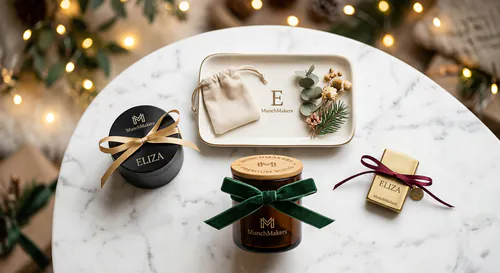
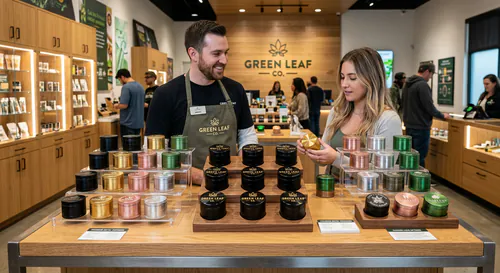
Physical promotional items work differently. When a customer walks out with your logo on something they'll use every day, you're buying visibility that costs nothing after the initial unit price. The item does the work. You don't pay for placement, you don't bid on ad inventory, and you're not competing with a dozen other notifications in someone's phone. The branded accessory just sits there, being used, carrying your name into every session.
That's the core argument for investing in 420 promotional products, and it's why some of the best-run dispensaries treat merchandise as a marketing line item rather than an afterthought.
What actually makes a promotional product work
Three things determine whether a promo item earns its cost: utility, quality, and brand fit.
Utility is the most important. If the item gets used regularly, your brand gets seen regularly. If it ends up in a junk drawer, the impression count stops at one. Cannabis accessories have a natural advantage here because they're tied to an activity people do repeatedly. A grinder, a rolling tray, a lighter -- these aren't novelty items that wear out their welcome. They're tools.
Quality determines whether the item reflects well on your brand or quietly undermines it. A lighter that dies after ten uses or a grinder that jams on the first session sends a message about your dispensary. It's not the message you intended. The unit cost difference between a mediocre promotional item and a genuinely good one is usually $2 to $5 per piece. At any meaningful scale, that's a small premium for the difference between a product that embarrasses you and one that builds loyalty.
Brand fit is about whether the item actually belongs in a cannabis context. A dispensary giving away branded stress balls or mouse pads is wasting money. Your customers are cannabis users. Give them something that works in their world.
The core product lineup for dispensary promo
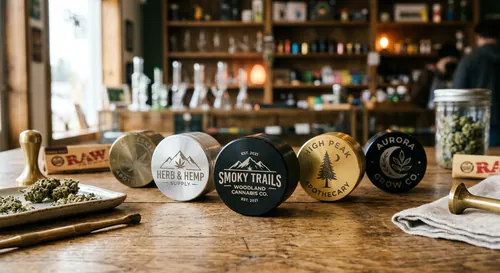
Custom grinders consistently rank as the highest-retention promotional item for dispensaries. The math is simple: a quality aluminum grinder with your logo costs $8 to $15 per unit at reasonable MOQs, and it will be in active use for two to five years. If a customer uses their grinder twice a day, your logo gets 1,400 impressions in the first year alone. No other promotional category gets close to that impression cost at that price.
The ROI case for grinders is strong enough that I've watched dispensaries shift significant chunks of their promo budget away from digital toward branded accessories. One dispensary group I know ran a campaign where every customer who spent $75 or more got a custom grinder at checkout. Return visit rate for customers in that cohort outperformed their standard loyalty program. They attributed it partly to the physical reminder of the brand sitting on the customer's desk at home.
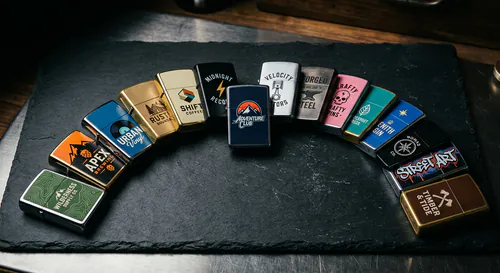
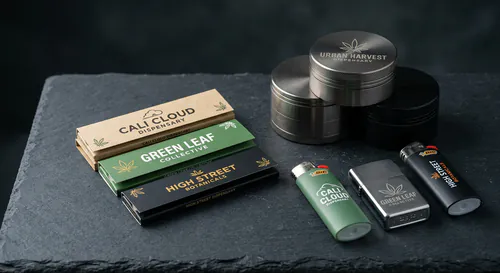
Custom lighters are lower cost per unit ($2.50 to $5 for quality branded options) and the highest volume item in most promo lineups. They're consumable, which means you need to reorder, but that also means customers who get a free lighter and run out are likely to come back for another one. Branded BIC lighters especially have a quality association that generic lighters don't carry. When your logo is on a BIC, the quality of the lighter reflects on you positively.
Custom rolling papers occupy a different category. They're consumable like lighters, but the branding opportunity is more specific. Every booklet puts your brand name in a customer's hand at the moment they're about to use your product. Custom rolling papers work well as dispensary-exclusive items -- something customers can only get at your location, which creates a reason to come back and a conversation piece.
Seasonal strategy: building around 420
April 20th is the single most important date on a dispensary's marketing calendar, and the promotional product strategy for that window is worth planning months in advance.
The mistake most dispensaries make is treating 420 as a single-day event. It's not. Consumer intent starts building in late March and carries through the last week of April. The promotional product you send out in the first week of April is still being used through May. Plan your merchandise order with that extended window in mind.
For 420 specifically, the product selection should skew toward items that feel celebratory. Limited-run artwork on a rolling tray, a grinder with a 420-specific design alongside your standard branding, a custom rolling paper booklet with a date-specific cover. These limited editions drive urgency in a way that standard promo items don't. Customers who missed out on last year's 420 grinder will make a point to get this year's.
Budget allocation: if you're running a meaningful 420 campaign, think about three tiers. A threshold gift (spend $50, get a branded lighter) that most customers can access easily. A mid-tier item (spend $100, get a rolling tray or grinder) that rewards higher purchases. And a limited, premium item available only in small quantities -- maybe 50 or 100 units -- that creates genuine scarcity and social sharing. Each tier serves a different customer segment and a different marketing objective.
Budget planning for different dispensary sizes
Small independent dispensary, under $500k annual revenue: the budget for physical promo should be around $3,000 to $8,000 per year. Focus on one or two high-quality items rather than spreading across many. A batch of 300 custom lighters at $4 each is $1,200. A run of 100 branded grinders at $12 each is $1,200. That's a sustainable annual spend that puts quality items in front of every customer who crosses a certain purchase threshold.
Mid-size multi-location operation, $2M to $10M revenue: promo budgets in this range typically run $15,000 to $40,000 per year across locations. You can afford to run seasonal campaigns, maintain a permanent counter display of giveaway items, and do special runs for events. At this scale, custom rolling papers become economical because you have the volume to justify the MOQs. Consider co-branding opportunities with local cannabis brands -- they share the cost, you both get distribution.
Large MSO or well-funded single location: promotional merchandise becomes a real brand-building tool at this scale. Custom product lines, limited editions, packaging that matches the retail environment. Budget of $50,000 to $150,000 annually isn't unusual, and the ROI at scale can be tracked with enough precision to justify it. You're building a brand identity that extends beyond the dispensary walls.
Compliance: what you need to know before you print
Cannabis marketing regulations vary significantly by state, and some of them apply to promotional items in ways that aren't immediately obvious.
The core issues to be aware of: most states prohibit cannabis marketing that appeals to minors. This affects imagery choices. Cartoon characters, bright colors that read as childlike, and certain icon styles have been flagged in various state enforcement actions. Your promotional items should look like they're made for adults, because regulators will hold you to that standard.
Some states have restrictions on off-premises advertising, which can apply to branded items given away outside the dispensary. If you're doing an event sponsorship or sending branded items to an off-site partner, check your state's specific rules.
Claims matter. Don't put anything on a promo item that could be read as a health claim or a potency claim. The item is a marketing tool, not a product label, but regulators have cited dispensaries for branded merchandise that included claims about effects.
Labeling requirements for consumable items are also relevant if you're ever putting your brand on something that gets consumed. Rolling papers fall into a regulatory gray area in some states. Get compliance advice specific to your state before printing something that could become a problem.
Co-branding: making your budget go further
A tactic that's underused in the cannabis space is co-branded promotional merchandise. The model is straightforward: a cannabis brand with wholesale distribution to your dispensary shares the cost of a promotional run in exchange for placement on the item alongside your dispensary branding.
From the brand's perspective, it's distribution and impressions. From your perspective, it's subsidized merchandise. A co-branded grinder where the dispensary and the cannabis brand each put up $5,000 for a run of 1,000 units gets both parties a better unit price and wider distribution than either would get independently.
The dynamics work best when the brand's identity complements yours. Two brands fighting for visual dominance on a 2-inch grinder lid creates a cluttered result. The best co-branded pieces are ones where the relationship makes intuitive sense to the customer and both logos have room to breathe.
Measuring whether any of this is working
Promotional merchandise is notoriously hard to attribute, but there are ways to get useful data without running a controlled trial.
Tie giveaways to a specific transaction threshold and track that cohort's return rate and lifetime value against customers who didn't receive a merchandise item. This isn't a perfect A/B test, but it gives you directional signal. If the cohort that received a grinder is returning at a meaningfully higher rate over the next six months, that's evidence the investment is doing something.
For events specifically, measure new customer acquisition separately. If you're giving away branded items at a 420 event and tracking how many new customer accounts get created in the two weeks following, you can make a rough calculation about the cost to acquire each new customer through that channel versus your digital channels.
The qualitative signal matters too. When customers come in mentioning the grinder you gave them, or posting it on social media, or asking if you have more of the rolling papers, you're getting organic evidence that the item is working. Track it informally if you can't track it systematically.
Where to start if you haven't done this before
If your dispensary hasn't built out a promotional merchandise program, start with a single product and a defined use case. Don't try to launch a full lineup of branded accessories in one order.
My recommendation: start with custom lighters. They're the lowest cost per unit, the most universally useful, and they give you fast feedback on how customers respond to branded items. Order 200 to 300, hand them out with purchases over $40 for a month, and see what happens to repeat visit rates in that cohort. The data you get from that small test is worth more than any product presentation.
Once you've validated that physical merchandise is worth the investment in your specific context, expand. Add a grinder tier for higher purchase thresholds. Add custom rolling papers as a seasonal or exclusive item. Build the lineup around what your customers actually respond to, not around what looks good in a product catalog.
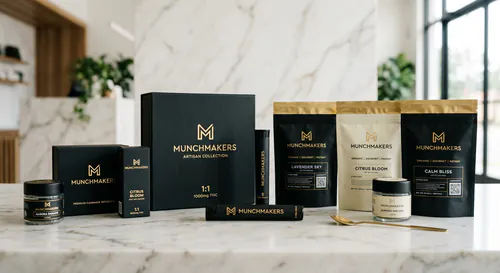
MunchMakers works with dispensaries at every stage of this process, from first-time merchandise buyers figuring out MOQs to established operations running annual promotional calendars. For more on the specific ROI case for one product category, the deep dive on custom grinders and dispensary marketing ROI is worth reading. And if you're building out the full picture of what a promotional product strategy looks like for the cannabis industry specifically, the guide at 420 promotional products for dispensaries covers the wholesale and merchandise planning side in more detail.
The dispensaries doing this well aren't treating promotional merchandise as a nice-to-have. They're treating it as a media channel with a cost per impression they can calculate and a customer retention effect they can measure. That mindset shift is where the real ROI starts.