Where the industry is right now
The cannabis industry in early 2026 looks different from what most people projected three years ago. Federal rescheduling has moved to Schedule III, which was meaningful for some things -- 280E tax relief has started to improve operator financials in a real way -- but interstate commerce remains blocked, the banking situation is still messier than it should be, and the hoped-for federal legalization wave has not materialized on the timelines anyone predicted. State-by-state legalization continues at a slow pace. Ohio went adult-use in 2024. Delaware, Minnesota, and several others added adult-use programs in 2023 and 2024. The map is expanding, but carefully.
What this means practically: the industry is maturing without the structural simplification that federal legalization would have provided. Operators are competing in an environment where some of the most basic business problems (banking, insurance, interstate supply chains) remain complicated, while consumer demand continues to grow and price compression in flower has squeezed margins across most markets. The brands and dispensaries doing well in 2026 have adapted to this reality rather than waiting for a policy change to make things easier.
280E relief and what it actually changes
For years, 280E was the structural tax problem that made cannabis retail profitability genuinely difficult. Cannabis businesses couldn't deduct ordinary business expenses -- no deduction for payroll, rent, marketing, or general overhead. You paid federal income tax on gross profit rather than net profit. A dispensary with $3 million in revenue, $1.5 million in cost of goods, and $1.2 million in operating expenses had a federal tax bill calculated on $1.5 million rather than $300,000 in actual net income. The effective tax rates were in some cases above 70 percent of actual profit.
Schedule III rescheduling changes this. With cannabis no longer a Schedule I substance, 280E's restrictions no longer apply. A dispensary that was paying $400,000 in federal taxes on $3 million in revenue might now pay $90,000. That's real money, and it's already showing up in improved operator cash positions for the businesses that planned around it correctly.
The caveat: the regulatory implementation of Schedule III is still being finalized as of early 2026, and there's litigation. Not every cannabis business has the same legal structure, and the relief isn't uniform. If you haven't talked to a cannabis-focused tax attorney about your specific situation since the rescheduling decision, you should. The broad strokes favor profitability; the specifics depend on your structure.
Craft and premium cannabis is pulling away from the commodity tier
Flower prices at the commodity level have been in near-continuous decline for the past four years in most legal markets. The average price per gram in California dropped from around $10 in 2020 to under $5 in many dispensaries by 2024. In Oklahoma, which licensed more dispensaries per capita than any other state, prices hit $3 per gram or below for mid-shelf product. That compression has pushed thin-margin operators out and forced price-sensitive brands into profitability problems they can't solve by selling more units.
What's happening at the other end of the market is more interesting. Craft cannabis -- genetics-focused, small-batch, often greenhouse or sun-grown with documented cultivation practices -- has held pricing power in markets where consumers have the sophistication to pay for it. Brands in California, Oregon, and Michigan selling in the $18 to $25 per gram range for premium flower have maintained those prices while the commodity shelf has compressed. The value proposition is specific genetics, documented terpene profiles, verifiable cultivation practices, and brand story.
This bifurcation is probably permanent and is accelerating. Mass-market flower is becoming a commodity business with commodity margins. Premium and craft cannabis is a specialty product business with the pricing power that implies. Dispensaries and brands that haven't made a deliberate choice about which end of this market they're serving are getting squeezed by both sides simultaneously: too expensive for the bargain hunters, not premium enough to attract the quality-first buyers who will pay $25 a gram without complaining.
Social equity licensing: where it stands and what it means operationally
Social equity programs exist in most adult-use states at this point, though their design and effectiveness vary enormously. Illinois, Massachusetts, New York, and California have the most developed programs, each with different structures, different outcomes, and different problems.
New York's rollout has been the most-watched case study, partly because it was genuinely ambitious and partly because the implementation has been difficult. The state prioritized social equity licensees, created a Conditional Adult Use Retail Dispensary program that was supposed to fast-track equity operators, and then ran into a series of legal challenges from existing operators, supply chain complications, and infrastructure problems that left many early licensees unable to open for more than a year after receiving their license. The intent was right; the execution has been a cautionary tale in how not to run a licensing rollout.
For brands and dispensaries in markets with social equity requirements, the practical implication is understanding both your obligations and your opportunities. Some states require that a percentage of purchases or procurement come from social equity-licensed producers. Others provide operational support or capital access programs for equity licensees. Knowing what your state requires and what it offers is baseline knowledge for 2026 operators.
Technology integration: loyalty apps and AI personalization
The technology gap between cannabis retail and general consumer retail has been narrowing. The best dispensary POS systems now integrate with loyalty platforms, CRM tools, and delivery infrastructure in ways that most cannabis retailers weren't even thinking about four years ago. Springbig, Dutchie, and Blaze are among the platforms that have built out relatively sophisticated customer engagement tooling on top of their transactional infrastructure.
AI personalization in cannabis retail is early but real. Systems that analyze a customer's purchase history and suggest products they're likely to want, or that trigger personalized outreach based on behavioral signals, are being deployed by multi-location operators and some single-location shops with the technical staff to implement them. The data advantage of having detailed purchase history for thousands of customers is substantial -- a dispensary that knows that a specific customer always buys indica-dominant flower in the $15 to $20 range, shops on Thursday evenings, and hasn't visited in 18 days can send a better message than a generic promotional email.
The catch is that most dispensaries don't have the staff or the technical sophistication to implement these tools well, even when they have access to them through their POS. The dispensaries doing this best tend to have either a dedicated marketing person who owns the CRM and loyalty platform, or a partnership with an agency that specializes in cannabis customer engagement. If you're paying for a loyalty platform and using it only for points tracking, you're leaving significant capability on the table.
Packaging compliance is getting stricter
State packaging requirements continue to evolve, and they are generally moving toward more restrictive rather than more permissive. The universal THC symbol (the exclamation point within a triangle or stop sign shape), mandatory warning language, child-resistant requirements, and single-serving labeling for edibles have all expanded in scope across states in the past two years.
California's packaging regulations in particular have become more specific about what constitutes "appealing to minors," which has caught some brands with imagery that previously seemed compliant. A cartoon-adjacent design on an edible package, even without explicitly cartoon characters, has been enough to trigger enforcement action in some cases. The safe design approach for 2026 is conservative on imagery for edibles and concentrates, and assuming that regulators will interpret any ambiguity against you.
Sustainability requirements are arriving too. California has enacted requirements for recycled content in cannabis packaging, and several other states are working on similar rules. The cost of compliance-friendly branded cannabis packaging has come down as more suppliers have entered the market, but the planning required has gone up. Redesigning packaging reactively after a regulatory change is significantly more expensive than designing ahead of it.
Branded accessories as a differentiator
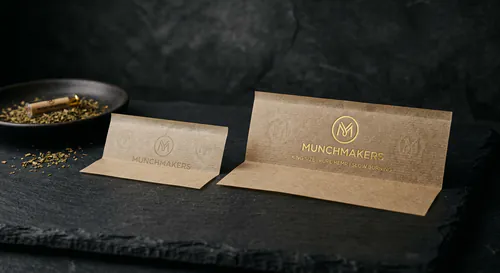
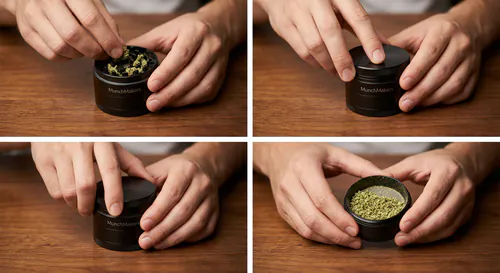
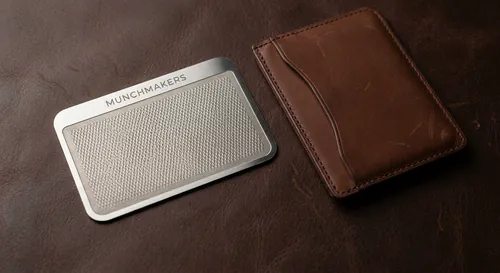
One of the clearest trends in cannabis brand building over the past two years is the expansion of branded accessories from a promotional item into a product line in its own right. Brands that previously thought of a custom lighter as a trade show giveaway are now building out branded merchandise programs that include grinders, rolling trays, papers, and storage that customers seek out and pay for.
The logic is straightforward. In a market where flower pricing is under pressure and product differentiation is hard to sustain (a competitor can source similar genetics), the brand touchpoints that live in a customer's home are among the most durable differentiators available. A customer who uses a branded rolling tray, stores their flower in a branded jar, and reaches for a branded lighter at every session is having a brand experience multiple times per day. That frequency of contact is unavailable through any digital advertising channel at any budget.
The brands doing this well have treated their merchandise with the same design standards as their core product packaging. The ones doing it poorly are handing out cheap lighters with a logo slapped on. The difference in how customers perceive those two approaches is large. MunchMakers works specifically in this space, and the inquiry we see from brands has shifted noticeably from pure promotional giveaway toward genuine product line development. For how to think about this alongside your broader marketing program, the post on cannabis brand identity covers the strategic framework.
Online ordering and delivery: the market share story
Online ordering plus in-store pickup has become table stakes for dispensary retail in most legal markets. Customers who started using pickup ordering during 2020 and 2021 have not reverted to walk-in only browsing. Most dispensaries now see 30 to 50 percent of their orders originate online, and in urban markets with active delivery programs, delivery can represent 20 to 35 percent of total revenue.
The delivery market has consolidated significantly. The early surge of third-party delivery platforms in cannabis has narrowed to a smaller group of regional and national players, and many multi-location dispensaries have moved to first-party delivery rather than relying on third-party platforms. The margin math on third-party delivery in cannabis is typically unfavorable: platform fees of 15 to 25 percent on top of driver costs often make delivery revenue look worse than in-store revenue on the same product at the same price.
First-party delivery -- your own drivers, your own logistics, your own customer relationship -- has better economics but requires operational investment. The dispensaries running successful first-party delivery programs in 2026 are generally doing 50 or more deliveries per day, which provides enough volume to justify the operational overhead. Below that threshold, a hybrid approach (in-house for local core area, third-party for extended radius) often makes more sense.
Multi-state operator consolidation: reading the signals
The multi-state operator (MSO) consolidation wave that was predicted with confidence three years ago has happened, but more slowly and more selectively than anticipated. Curaleaf, Green Thumb, Trulieve, and Cresco remain the major players, but all of them have been through periods of retrenchment and strategic refocus. The unlimited capital era for cannabis MSOs ended when the public markets reassessed cannabis sector valuations in 2022 and 2023, and the recovery has been partial.
What's happening now is more targeted: MSOs acquiring strong regional operators in newly legal or under-penetrated markets, divesting in low-margin markets where they can't compete profitably, and focusing on markets where their operational scale creates real cost advantages. Florida, for instance, has seen significant MSO investment as the state's market has grown. Markets like California and Oregon, where oversupply and licensing have compressed margins industrywide, have seen some MSO exits or reductions.
For independent operators, this environment has a specific implication: the MSOs are not a monolithic threat that makes independent operation unviable. In markets where MSO presence is heavy, independent differentiation through local brand identity, community connection, and customer experience is a real competitive moat that scaled operators can't easily replicate. The dispensaries surviving and growing against MSO competition in mature markets are almost uniformly the ones with strong local brand identity and genuinely loyal customer bases. The strategies for building that loyalty are covered in more detail in the post on dispensary customer retention.
What to do with all of this
Across these trends, a few actionable conclusions hold regardless of your market or business type.
If you haven't had a cannabis-specific tax review since Schedule III rescheduling, do that now. The 280E relief is real money that belongs in your operation, not with a federal government that constrained your advertising, banking, and interstate commerce for years.
If you're in flower, make a deliberate positioning choice. Competing in the middle is increasingly where margins go to die. Either own the value tier with operational efficiency that lets you make money at $4 per gram, or own the premium tier with cultivation quality and brand story that justifies $18 and above. The undifferentiated middle is getting squeezed from both directions.
Invest in your customer relationships before you invest in customer acquisition. In a market where advertising is constrained and acquisition costs are high, the customers you already have are your best asset. The technology to manage those relationships better than you currently do almost certainly exists within the platforms you're already paying for -- you just need to use it.
And treat your brand as a long-term investment. The visual identity, the physical touchpoints, the branded accessories that live in customers' homes -- these are not tactical marketing expenses. They're infrastructure for the kind of customer loyalty that doesn't evaporate when a competitor opens across the street.