The teeth are the whole point of a grinder. Everything else -- the chambers, the screen, the magnet -- supports what the teeth do. Yet most people shopping for a grinder barely think about tooth design, and most product listings don't explain it well. This guide covers the main tooth designs, what each one does in practice, and what actually wears out first.
Diamond-cut teeth
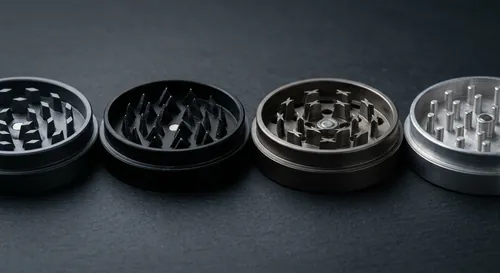
Diamond-cut teeth are the most common design in quality grinders and the standard I'd recommend for most people. The teeth are machined into a four-sided pyramidal shape with sharp angled edges on all sides -- like a small diamond point. When herb passes between two rows of opposing diamond teeth, it gets sliced from multiple angles simultaneously.
The result is a consistent, fluffy grind without a lot of compression. Diamond teeth cut through bud rather than tearing it, which matters for maintaining the integrity of trichomes on the surface. Tearing mechanically breaks trichome stalks; cutting leaves them more intact. For kief collection, this means more material falls through your screen rather than getting smashed into walls.
Diamond teeth also handle dense, sticky material better than most other designs because the angled faces create a shearing motion that works through resistance. They're efficient on medium to dry herb. On very fresh, wet herb, no tooth design works particularly well -- the material compresses instead of cuts.
The XL grinder with diamond teeth is a good example of why tooth geometry matters at scale: at larger diameters, diamond-cut teeth maintain consistent grind quality across the whole chamber width in ways that simpler designs don't.
Shark teeth / peg-style teeth
Shark teeth (sometimes called peg teeth) are cylindrical or blunt-tipped pegs arranged in alternating rows. The grinding mechanism is less about cutting and more about grabbing and tearing. Herb gets caught between opposing pegs and pulled apart.
Peg grinders work and they're simpler to manufacture, which is why they appear on a lot of budget grinders. The grind tends to be coarser than diamond-cut and less consistent -- you end up with some fine material and some larger pieces rather than a uniform result.
Where peg grinders hold up is with very large, loose buds that need aggressive breaking down before finer grinding. The tearing action handles bulky material that diamond teeth might catch on. Some people prefer the slightly coarser grind for bowl packing specifically, where too fine a grind can restrict airflow through the bowl.
The downside is that peg teeth are the first to show wear. The rounded tip of a peg wears flat from repeated contact, and a flat peg doesn't grip -- it just slides over the herb. When you notice your grinder requiring more effort to turn and producing progressively less consistent results, worn peg teeth are usually the culprit.
Cross-blade / X-blade teeth
Cross-blade designs come from electric grinder technology. Instead of opposing rows of individual teeth, the grinding mechanism uses one or two blades that spin through the material. The result is more like a food processor than a traditional grinder.
In manual grinders, cross-blade designs appear on some flat-disc grinders where the blades are fixed in a radial pattern. They grind quickly and handle large amounts of material at once, but they produce a very inconsistent result -- fine powder mixed with fibrous chunks -- because the blades cut in a single plane rather than working through material from multiple angles.
Electric grinders almost universally use some version of cross-blade or spinning-blade design because speed matters more than consistency in that format. For manual grinding where you control the rotation, traditional tooth designs generally outperform blades for consistency.
Tooth count and grind quality
More teeth doesn't always mean a better grind. It depends on the tooth geometry and chamber diameter. A smaller grinder with 20 diamond teeth can outperform a larger grinder with 40 peg teeth just based on cutting geometry.
What matters is the ratio of tooth coverage to grinding chamber area. Too few teeth means some material escapes contact and rotates without being processed. Too many teeth in a small space means teeth start interfering with each other and the material gets compressed rather than cut.
Most quality 2.5" diameter grinders land between 20 and 30 teeth on each half, which is a well-tested range for consistent grind with diamond-cut geometry.
How to spot a dull grinder
A grinder is getting dull when rotation requires noticeably more force than it used to. If you're pressing the halves together and cranking harder to get the same result, the teeth are worn.
Check the tips: on diamond-cut teeth, look at the peaks. If they've rounded off or flattened, they're no longer cutting cleanly. On peg teeth, look at whether the pegs have a visible flat spot on top. Either way, the fix is usually a replacement grinder -- resharpening teeth at home isn't practical.
The other symptom is inconsistent grind with visible large fragments remaining after normal rotation. When you open the collection chamber and see recognizable chunks alongside fine powder, the teeth aren't engaging the material uniformly anymore.
Why tooth design matters for custom grinders
For anyone commissioning quality herb grinders -- whether for personal use or branded dispensary merchandise -- specifying diamond-cut teeth is a concrete quality decision, not just a preference. MunchMakers grinders use diamond-cut tooth design for exactly this reason: the grind consistency and kief preservation make a real difference in daily performance, and it's one of the details that distinguishes a grinder that lasts from one that frustrates after six months.
If you're trying to compare grinder quality across materials rather than just tooth design, the grinder materials comparison guide covers the aluminum vs titanium vs zinc alloy question in detail. And if you want to keep whatever grinder you have performing well for longer, the cleaning and maintenance guide has the full routine.