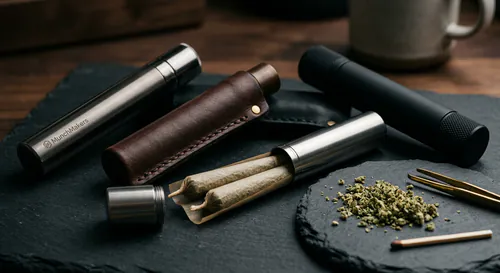
Why carrying pre-rolls without a case is a bad idea
A joint in a pocket without protection does one of three things: it gets crushed, it gets damp from body heat and humidity, or the tip gets bent and it won't draw properly. I've ruined more than a few pre-rolls this way before I got serious about carrying something designed for the job. The fix is a joint holder, and the category has gotten much better in recent years.
The basic function is simple: protect a joint or pre-roll from physical damage, moisture, and smell during transport. But within that basic function there's a lot of variation -- in material, capacity, smell-proofing, water resistance, and how discreet the piece actually is. Let's go through all of it.
Types of joint holders: a complete breakdown
The market has several distinct formats, each with real advantages for specific use cases. Knowing which type you need before you buy saves a lot of trial and error.
Single-joint tubes are the most common and simplest format. A cylindrical tube, usually with a screw cap, sized to fit one or two joints. They come in metal, plastic, and glass. The metal ones -- aluminum or stainless -- are the most durable and often the most discreet because they look like any other small container. Plastic tubes are lighter and usually cheaper, though quality varies widely. Glass tubes are available but fragile, making them a poor choice for carry.
Multi-joint cases hold three, five, or more pre-rolls in a single case. These are the better format if you're bringing enough for a session with friends or if you're a frequent enough smoker that reloading a single tube constantly is annoying. The form factor is usually more rectangular -- think of a small cigar case. Some have individual slots to prevent joints from rubbing against each other and losing shape.
Doob tubes are the thin, clear plastic cylinders that most dispensary pre-rolls come packaged in from the factory. You've definitely seen these. They're fine for short-term storage but were designed for packaging, not repeated use. The caps wear out, they're transparent (no smell containment to speak of), and they crack over time. Think of them as one-use packaging rather than a long-term holder.
Waterproof joint cases are purpose-built for outdoor use, water sports, hiking, and any environment where your joints might get wet. The seal on a true waterproof case is fundamentally different from a standard screw cap. Look for cases that specify IP67 or IP68 ratings, or that use a compression-seal closure similar to what you'd find on dive equipment. A case that claims to be waterproof without a specific rating is usually just splash-resistant. The waterproof joint case is worth considering if you're active outdoors -- it handles submersion, not just splashes.
Leather joint cases are a real format that several makers produce. They look excellent and feel substantial in a jacket pocket, but they provide almost no crush protection compared to a rigid case and zero water resistance. They're an aesthetic choice rather than a practical one.
Metal tubes: the practical standard
Aluminum and stainless steel tubes have been the go-to format for serious smokers for a long time, and there's a reason they've stuck around. They're light, genuinely durable, and the screw-cap closure creates enough of a seal to contain most of the smell during short-term carry.
The quality differences in metal tubes are real but subtle. The main things to look for are wall thickness (thin-walled aluminum dents easily), cap thread quality (loose threads strip out and the cap falls off), and the internal diameter relative to what you're carrying. Most standard joints fit a tube with a 10mm to 12mm internal diameter. King-size or fatter joints need at least 13 to 14mm. Check the specs before ordering.
Smell containment on a screw-cap metal tube is partial, not complete. The thread creates a barrier, and for short distances or brief carry, it works well enough. For prolonged carry in a confined space (a car, a bag that someone is sitting next to), the smell will eventually get through. If you need true smell-proofing, see the section below on sealed cases.
Anodized aluminum tubes come in a wide range of colors and accept laser engraving cleanly, which is why they're a popular choice for custom branded holders. Dispensaries give these out as part of pre-roll purchases, and the branding reads well on the cylindrical surface.
Plastic and acrylic options
Hard plastic cases are lighter than metal and often cheaper. For basic daily carry that doesn't involve outdoor or wet conditions, a quality ABS plastic case works fine. The tradeoff is that plastic takes impact damage differently than metal -- it cracks rather than dents, and once cracked, the seal is compromised.
Acrylic is clear plastic, which some people prefer for being able to see the joint inside. It's more brittle than ABS and scratches easily, so the clarity degrades over time. I'd skip acrylic for anything meant for regular carry.
There's a category of polycarbonate (PC) plastic cases that are genuinely impact-resistant and lighter than metal while being more durable than standard ABS. These are worth seeking out if you want a lightweight case for active use. The material is the same used in safety glasses and some phone cases.
How to evaluate smell-proof performance
The phrase "smell-proof" gets used a lot more liberally than it should be. A standard metal tube with a screw cap will contain smell for a short time; it won't contain smell across a long day in a confined space. True smell-proofing requires an airtight seal, which usually means a silicone gasket under the cap or a compression closure.
The test I use: close the loaded case, leave it in a parked car for thirty minutes, then open the car and evaluate. Standard screw caps usually fail this test. Gasket-sealed caps usually pass it. Compression closures pass it consistently.
Activated carbon lining, used in some premium cases and pouches, adds another layer of odor absorption. It's more common in bags and pouches than in rigid cases. If smell-proofing is your top priority, a pouch with activated carbon lining will outperform a rigid case without one, at the cost of crush protection. The guide to smell proof weed storage covers this tradeoff in detail, including bags, jars, and cases across the full range of options.
Capacity: how many joints do you actually need to carry?
This is a personal answer, but it's worth thinking about before you buy. A single-joint tube is enough for solo daily carry. If you smoke with other people regularly, a 3-5 joint case is more appropriate. If you're attending an event or being a generous host, a case that holds 5-10 pre-rolls makes more sense.
The capacity question also affects form factor. A single-joint tube fits in any pocket without being noticeable. A case holding ten joints is significantly larger and may not fit in a front pocket at all. Think about where you'll be carrying it before you default to maximum capacity.
Some cases have a mixed design: one or two protected compartments for whole joints, plus a small separate section for a filter tip booklet, a small grinder, or a lighter. These combination cases are genuinely useful if you want everything for a session in one piece. They're thicker than a straight case, but for a jacket pocket or a bag, the trade-off is worth it.
Product comparison: which format for which person
Let me lay this out directly rather than hedge.
If you smoke solo, carry casually, and don't need waterproofing: a quality aluminum screw-cap tube in the right diameter is your best choice. Light, affordable, and durable enough for daily carry. Look for anodized aluminum with a tight thread.
If you hike, surf, kayak, ski, or otherwise spend time in wet conditions: the only format that makes sense is a certified waterproof case with a compression or gasket seal. Everything else is just hoping for the best. The waterproof joint case handles this category well.
If smell-proofing during extended carry is important: add an activated carbon pouch, or use a case with a silicone-gasket cap alongside a smaller outer bag with carbon lining. A case alone won't get you all the way there for all-day carry.
If you're sharing with others and need capacity: a multi-joint case with individual slots is worth the extra size. The slots prevent joints from shifting and bruising against each other, which matters if you're carrying pre-rolls for a few hours before you use them.
If you want something that looks good: leather cases exist, metal cases with clean finishes look genuinely elegant, and there are glass-and-metal combinations that feel premium. Prioritize the functional requirements first, then choose the nicest-looking option that meets them.
Travel considerations
Carrying pre-rolls across state lines is a separate legal question from the product choice, and I'm not going to address that. Within states where it's legal, the practical travel considerations are about smell, airport security, and format.
For car travel: a sealed case inside a closed bag is the standard approach. The gasket-sealed case slows smell considerably, and adding it to a bag rather than leaving it on the seat reduces direct exposure.
For air travel: cannabis is federally illegal in the US, and TSA is a federal agency, full stop. This isn't a judgment call.
For international travel: same answer, and the legal consequences outside the US vary dramatically.
For road trips within legal states where you want both smell containment and protection from heat and light: a combination of a gasket-sealed case inside a smell-proof pouch in a bag stored out of direct sun is the most complete approach. The guide to finding the best joint holder covers some of these combinations in more detail.
Maintenance and cleaning
Joint holders need cleaning more often than most people actually clean them. Resin and tar build up inside any case or tube that gets regular use, and the buildup eventually affects smell containment and even transfers to the outside of new joints you put in.
Metal tubes are the easiest to clean. A cotton swab with isopropyl alcohol reaches the interior easily on most single-joint tubes. For multi-joint cases, a pipe cleaner or a small brush with isopropyl works well. Rinse with clean water and let it dry fully before use.
Plastic cases need a gentler touch -- high-concentration isopropyl can cloud or weaken some plastics over time. Soapy warm water with a brush is safer for most plastics. If your case has a silicone gasket, pull it out before cleaning and check it for wear. A damaged gasket eliminates the smell seal, so replace it if it's cracked or deformed.
Leather cases are spot-clean only. Don't submerge them or use harsh solvents. A slightly damp cloth removes surface contamination; condition the leather occasionally to keep it supple.
Custom branded joint holders
For dispensaries, custom branded joint holders are one of the sharper marketing moves in the accessories category. A tube with your logo that comes with every pre-roll purchase is genuinely useful to the customer, and it leaves your branding in their regular rotation. Unlike a branded bag that gets thrown away, a quality joint holder gets used repeatedly.
The customization is usually pad printing or laser engraving on aluminum, with similar considerations to other metal accessories: simple designs that read clearly on a cylindrical surface, vector artwork files, and a minimum order quantity that depends on the print method. For more on how the full range of joint cases and holders works for branding purposes, the product category page is a good starting point.
The ROI math on branded joint holders is compelling because the retention rate is high. People keep functional accessories -- they don't have the same disposability as a branded bag or a paper receipt. Your logo is with them every time they smoke.
Picking one
The honest answer is that most regular smokers should own at least two: a simple metal tube for quick daily carry, and a sealed waterproof case for outdoor and active use. Between those two formats, you cover the majority of real-world scenarios.
Spend your money on quality materials -- the difference between a $5 aluminum tube with loose threads and a $15 one with clean machined threads is noticeable after two weeks of daily use. For multi-joint cases, check that the closure mechanism is genuinely airtight if smell matters to you. For waterproof cases, verify the IP rating rather than trusting marketing copy.
The right joint holder is invisible when it's working -- you don't think about it, the joint arrives intact, and it doesn't announce itself in your pocket or bag. When you find one that does all that reliably, you'll use it for years.