Why rolling papers work better than most promo items
Dispensaries spend money on branded merchandise constantly: t-shirts, hats, stickers, lanyards. Most of it ends up in a drawer or gets used once. Custom rolling papers are different because they get used up. A customer takes a branded booklet home and uses it over several sessions, each time seeing the logo on the cover. When the booklet runs out, they either bought more herb from you, or they need more papers. Either way, the brand interaction happens naturally, repeatedly, over days or weeks.
That's the core argument for rolling papers as a marketing product, and it's a strong one. The cost per impression ends up very low compared to items that only get noticed once.
What "custom" actually means with rolling papers
There are a few distinct levels of customization available, and they're not all equal in impact or cost.
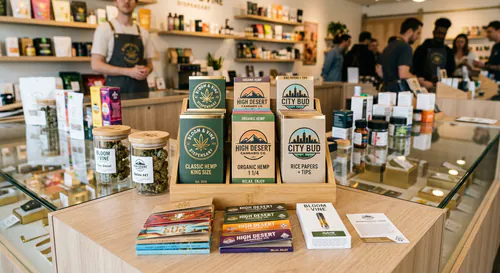
The most common is custom booklet covers. The paper itself is standard quality, but the cardstock booklet that holds the papers gets printed with your logo, colors, and any messaging you want. This is the most affordable entry point and looks sharp if the design is done well. For most dispensaries, this is the right choice.
Custom tip booklets are the next level. Filter tips (crutches) come in their own booklet, and that cover is printable too. Pairing custom paper booklets with custom tip booklets creates a matched set that looks like a branded product rather than a promotional afterthought. The cost increase is modest and the perceived quality difference is significant.
Printed papers -- where the logo or artwork appears on the paper itself -- are possible but require more careful vetting. The ink or dye has to be food-safe because the paper comes into contact with something being burned and inhaled. Reputable manufacturers use vegetable-based or soy-based inks and can provide certification documentation. If a supplier can't tell you what's in their paper ink, that's a hard pass. There are legitimate printed paper suppliers, but you need to ask the right questions.
Custom cones are a fourth option that's gained traction with dispensaries selling pre-rolls. You can have cones made with your brand on the packaging or on the cone tip. For dispensaries running a pre-roll program, branded cone packaging turns every pre-roll sale into a brand impression.
Design considerations that most brands get wrong
A rolling paper booklet is small. The printable area on a standard 1 1/4 booklet cover is roughly 50mm x 40mm, sometimes a bit more depending on the format. That's a postage stamp. Most dispensary logos were designed for storefronts and websites, not for stamp-sized reproduction.
The most common mistake is trying to cram too much into that space. A logo, a tagline, an address, a website, social handles -- all at once. The result is illegible at normal viewing distance. What actually works: a single strong visual element (the logo mark alone or the logo + brand name), clean negative space, and high contrast between the design and the booklet color.
Metallic foiling on the booklet cover is an option with some suppliers and it does look premium. If your brand has a gold or silver element, a foiled booklet reads as a quality product rather than a cheap giveaway. Worth the extra cost for a flagship promo item.
Color choices matter more on papers than on most surfaces because the background color of the cardstock interacts with printed colors differently than a screen or a sign does. Ask for a physical proof before approving a full production run. Digital mockups lie.
Material choice for custom papers
When you're ordering custom rolling papers, you're choosing not just the design but the paper quality inside the booklet. This matters because your brand is attached to the smoking experience. If you hand out a booklet of papers that burn fast, taste like burning paper, or don't roll well, the association is negative.
Hemp papers are the standard recommendation for branded products. They roll well, burn cleanly, and the slightly earthy flavor is less intrusive than wood pulp. Customers who smoke regularly will notice the difference between a hemp paper booklet and a generic wood pulp booklet. Hemp also aligns better with the cannabis category from a branding standpoint.
Rice papers are an option for brands that want to signal premium quality. The slow burn and minimal flavor are genuine selling points. The tradeoff is that rice papers are more difficult to roll, which matters if you're giving them to newer customers.
Avoid going with the cheapest paper option to save money on production. The whole point is to leave a positive brand impression. A paper that burns too fast or tastes bad undermines that.
Regulatory considerations
Cannabis marketing is heavily regulated, and rolling papers exist in an interesting gray zone. The papers themselves are tobacco accessories, not cannabis products. That means the advertising restrictions that apply to cannabis products (no endorsements, no health claims, no targeting under 21, etc.) don't technically apply in the same way to the paper booklets.
That said, you're a cannabis business, and regulators aren't naive. A dispensary logo on a rolling paper booklet is clearly cannabis-adjacent marketing. In states with strict cannabis advertising rules, check whether your state specifically addresses promotional item distribution. Most states have guidelines around what can be handed out in-store versus what can be mailed or distributed externally.
In-store distribution is generally the safest approach. Handing branded papers to verified adult customers at the point of sale is where the regulatory risk is lowest. Mail distribution (especially across state lines) or distribution at events requires more careful legal review depending on your state.
The paper ink question mentioned earlier isn't just a health consideration -- it's a regulatory one too. If you're distributing papers as a promotional product and someone asks about safety, you want to be able to produce documentation. This is another reason to source from reputable suppliers who can provide materials information.
MOQs, pricing, and what to budget
Minimum order quantities for custom rolling paper booklets typically start around 500 to 1,000 units. At those quantities, the per-unit cost is in the $0.80 to $2.00 range depending on paper quality, printing method, and supplier. At 5,000 units or more, per-unit cost drops significantly, often into the $0.40 to $0.80 range.
Custom tip booklets paired with papers add cost but not much. A matched paper and tip set can be sourced for $1.20 to $2.50 per set at reasonable quantities.
Turnaround times vary. Standard booklet cover printing with a domestic supplier is typically 3 to 4 weeks including proofing. For rush orders or more complex customization (foiling, embossing, custom paper printing), budget 6 to 8 weeks. Don't plan a 420 campaign around custom papers if you're starting the design process in March.
At MunchMakers, the custom rolling papers program is worth discussing early in the process so you know what's achievable within your timeline and budget. Getting a sample booklet before committing to a full run is standard practice and any credible supplier will offer it.
How dispensaries actually use them
There are a few distribution strategies worth thinking through, because how you give them away affects how much brand value you get out of them.
Handing a booklet out with every purchase above a certain spend threshold is the most common approach. It rewards your higher-value customers and the papers are used in sessions funded by your product, creating a tight loop between the brand and the experience.
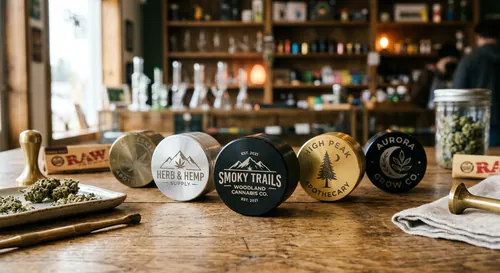
Including branded papers in a "starter pack" for new customers is a strong onboarding move. A new customer who walks out with a branded grinder card, a booklet of your papers, and a business card has a lot of brand touchpoints sitting at home. That first impression matters more than most dispensaries invest in.
Using papers as part of a loyalty program (redeem X points for a branded paper pack) adds perceived value to the papers and keeps the loyalty program interesting. Papers are inexpensive enough that you can offer them as a reward without hurting margin.
Event distribution -- farmers markets, cannabis cups, music events -- can work if the regulatory environment allows it and you have staff verifying age. The papers reach potential customers who haven't been to your store, which is different from the in-store model.
Papers as part of a broader branding strategy
Rolling papers work best when they're part of a coherent set of branded accessories rather than a standalone item. A customer who has your branded rolling papers, a booklet of your printed tips, and a lighter with your logo is living inside your brand every time they set up to roll. Each item reinforces the others.
The comparison to how papers fit into the general rolling paper ecosystem is worth understanding before you start designing. Our rolling papers buyers guide covers material types and what customers are already used to -- useful context for deciding what quality level to position your branded papers at.
There's also an argument that rolling papers are the most brand-loyal of all the accessories a smoker uses regularly. Lighters get borrowed and lost. Grinders live on a shelf. Papers get used deliberately, every session, held in the customer's hand. The logo is right there.
If you want to see how this plays into a broader custom product marketing strategy, the piece on rolling papers as business cards is worth reading -- it frames the brand impression argument in detail.
The one thing most dispensaries overlook
Quality. Not printing quality -- paper quality. A lot of dispensaries go with whatever's cheapest and then wonder why the branded papers don't seem to generate the goodwill they expected. Customers notice when the papers in the branded booklet are inferior to what they'd buy themselves. The association becomes negative.
Spend slightly more on the paper inside the booklet. Hemp over wood pulp, at minimum. The cost difference per unit is cents, and the difference in how customers perceive your brand is real. A dispensary that gives out genuinely good rolling papers with their logo on them gets remembered positively. One that gives out inferior papers gets forgotten, or worse, associated with a frustrating rolling experience.
That's the whole game with promotional products. You want the customer to pick up your branded item and have a good experience every single time. With rolling papers, you get multiple opportunities for that per booklet. Make them count.