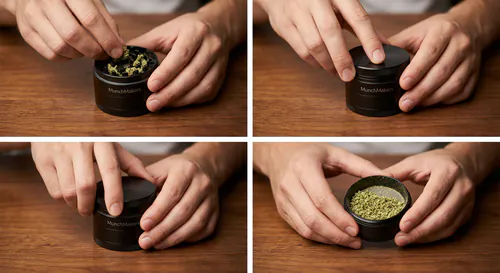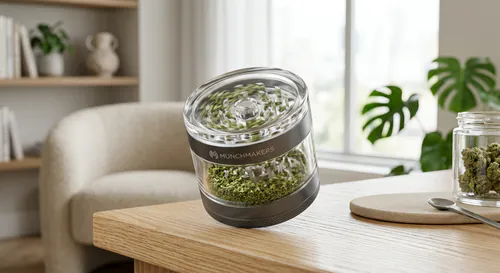
A clear top grinder is exactly what it sounds like: a grinder where the lid is made from transparent or translucent material instead of solid metal. You can watch the herb being ground through the top as you rotate. It's a small design change that has some real practical benefits and a few genuine trade-offs worth knowing about before you buy one.
Why a see-through lid changes how you grind
The most obvious advantage is being able to see when you've ground enough. With a solid metal lid, you're guessing -- rotating for what feels like a reasonable number of turns and hoping the result is the consistency you want. With a clear top, you can watch the buds break down in real time and stop when you see the texture you're after.
This turns out to be genuinely useful, not just a novelty. Different materials need different grind fineness for different purposes. Herb going into a vaporizer needs a finer grind than herb going into a joint. Herb for a bowl can be coarser still. Being able to see the process -- instead of opening the grinder, checking, closing, grinding more, checking again -- makes it faster and less messy to dial in.
For new users especially, a clear top grinder removes the guesswork during the learning process. There's a reason we recommend the beginner grinder guide alongside these -- the visual feedback makes the first few sessions less frustrating.
Acrylic vs polycarbonate: the material question
Most clear top grinders use either acrylic (PMMA) or polycarbonate (PC) for the transparent lid. Both are clear plastic, but they behave differently under the conditions a grinder lid experiences.
Acrylic is harder and clearer. Fresh out of the box, an acrylic lid looks more like glass -- very clear, high light transmission. The downside is that acrylic is brittle. It resists scratches reasonably well when new but chips and cracks more easily from drops or impacts than polycarbonate. It also doesn't hold up as well to repeated cleaning with solvents.
Polycarbonate is tougher but softer. It resists cracking and impact far better than acrylic -- polycarbonate is what they make bulletproof glass from at larger thicknesses. But it scratches more easily, so a polycarbonate lid that's been cleaned frequently or kept in a pocket with other objects will cloud and scratch faster than acrylic. It also has slightly lower optical clarity, particularly as it ages.
For practical daily grinder use, polycarbonate holds up better over time because drops are inevitable. The trade-off in optical clarity is real but livable. If you're buying for display or visual appeal rather than portability, acrylic's initial clarity is nice. If you're buying for actual use, polycarbonate is the more durable choice.
Cleaning considerations for clear lids
This is where clear top grinders require more attention than solid metal ones. Resin buildup on a metal lid is invisible unless you look at the inside face. Resin on a clear lid is visible from the outside and clouds the view. You'll want to clean more frequently.
The cleaning method matters. Isopropyl alcohol is safe on both acrylic and polycarbonate, but avoid harsh solvents like acetone -- acetone dissolves acrylic entirely and damages polycarbonate surfaces. A soft cotton cloth with isopropyl alcohol will remove most resin. For baked-on buildup, soaking the lid separately in warm isopropyl alcohol for 15-20 minutes usually clears it.
Don't use abrasive cloths or scrub pads on a clear lid. Micro-scratches accumulate and permanently cloud the material. A soft cloth is all you need.
When a clear top grinder is the right choice
If you use a vaporizer and grind for it regularly, the ability to see exactly when you've hit the fine grind a vaporizer needs is worth the slight maintenance overhead. Vaporizer users who own a clear top grinder often say they go back to guessing with solid lid grinders and find it frustrating by comparison.
If you're learning to grind and still figuring out what different grind textures look like and feel like, the visual feedback during rotation is genuinely educational. I'd recommend it as a first grinder for that reason alone.
If you tend to over-grind (grinding until everything is dust when a coarser texture would work better), seeing the process helps you stop earlier.
The durability trade-off
I won't pretend there's no trade-off. An all-metal grinder will outlast a clear-top grinder if we're talking about the lid specifically. Metal doesn't scratch, cloud, or crack from drops. A clear plastic lid will show wear over time in ways a metal lid never does.
This doesn't make clear top grinders a bad choice, but it does mean they suit certain use contexts better than others. If you're looking for a grinder that you'll carry in a bag or pocket daily for years, an all-metal lid might age better. If you're using your herb grinder at home on a desk or shelf, the durability question matters much less.
The grinder size and piece count guide is worth reading alongside this if you're choosing between configurations -- clear tops are available in both 2-piece and 4-piece designs, and the right piece count matters as much as the lid material for how the grinder fits your workflow.
For an entirely different approach to visual grinding -- one where the grinding mechanism itself is visible because it's electric -- the electric herb grinder offers a different kind of transparency in the process.