Use code for 10% off your order!

Code copied to clipboard!
Skip to main content
Wholesale Grinders for Dispensaries & Smoke Shops: Pricing, MOQs, and What to Look For

Wholesale Grinders for Dispensaries & Smoke Shops: Pricing, MOQs, and What to Look For

MunchMakers Team

What wholesale grinders actually cost -- and what that means for your margins

Most dispensaries and smoke shops end up paying too much for grinders because they buy in small quantities from a distributor that bought from another distributor. By the time the product reaches your shelf, two or three middlemen have taken their cut. Going direct to a manufacturer or a supplier like MunchMakers wholesale accessories changes that math considerably.

Here is roughly how grinder wholesale pricing breaks down at different order sizes, for standard 4-piece aluminum grinders:

  • 12--24 units: $6.00--$9.00 per unit (typical distributor pricing)
  • 50--99 units: $4.50--$6.50 per unit
  • 100--249 units: $3.00--$4.75 per unit
  • 250+ units: $1.80--$3.50 per unit

A grinder that retails for $19.99 at a 12-unit buy costs you roughly $9.00. Your gross margin is around 55%. At 250 units, that same product might cost $2.50, and your margin jumps past 87%. The MOQ (minimum order quantity) you commit to is probably the single biggest lever you have on unit economics.

Custom branded grinders add cost, but not as much as most buyers expect. Laser engraving on an existing design typically adds $0.50--$1.50 per unit depending on quantity. Full custom tooling for a proprietary shape or lid design runs $800--$2,500 as a one-time die cost, then drops back to near-standard per-unit pricing at volume. If your shop moves 50+ grinders a month, a custom logo grinder pays back its tooling cost fast.

Choosing the right material for a retail environment

The three materials you will see most often in wholesale grinders are zinc alloy, anodized aluminum, and stainless steel. Each has a real-world tradeoff that matters when you are stocking a retail floor.

Zinc alloy is the cheapest to manufacture and the most common at low price points. It is heavier than aluminum, which can read as "premium" to a casual buyer, but the threading wears faster and it is prone to chipping if dropped on a hard floor. For a smoke shop selling a $9.99 grinder to a college-town demographic, zinc alloy is fine. For a dispensary positioning itself around quality, it is a liability.

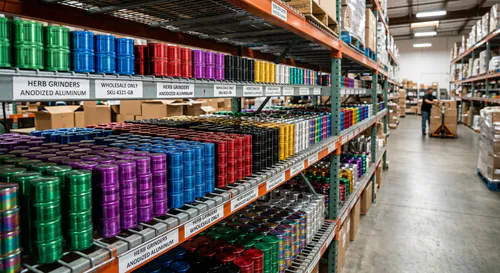
Anodized aluminum is where most serious retail inventory lives. It is light, the anodized coating resists scratches and holds color well, and the machined teeth stay sharp for years under normal use. Most 4-piece grinders in the $15--$40 retail range are anodized aluminum. At wholesale you are looking at $2.50--$6.00 per unit depending on size and quantity.

Stainless steel grinders cost more -- typically $8.00--$18.00 at wholesale for a quality piece -- but they hold up to the kind of abuse that display models take. If you run a floor display where customers handle product before buying, a steel or titanium-coated grinder will look presentable six months later. An entry-level zinc unit will not.

One thing that often gets overlooked: the magnet. Cheap grinders use a small, weak magnet that lets the lid separate in a bag or pocket. Any grinder you stock should have a neodymium magnet strong enough that you cannot separate the lid with one finger. This is a $0.10 component difference that causes more customer returns than almost anything else.

MOQs and what to negotiate

Standard MOQs from overseas manufacturers on unbranded grinders are usually 100--300 units per SKU. If you want a mix of sizes (say, a 55mm and a 63mm), each size counts as its own SKU toward the MOQ. That can trip up first-time buyers who think they can split an order across styles.

Domestic wholesalers and companies that stock product in the US typically have lower MOQs -- sometimes as few as 12 or 24 units -- but you are paying for that convenience. The per-unit cost is 40--80% higher than going direct.

What you can realistically negotiate:

  • Payment terms (net-30 is common once you have established history; new accounts usually pay upfront)
  • Free samples before committing to a full run
  • Mixed-size orders that count toward a single MOQ
  • Drop-in branding (laser engraving on existing stock) with no tooling fee

What you usually cannot negotiate on a first order: the MOQ itself, lead times (6--10 weeks for custom production from overseas), or per-unit price below the published tier. Once you have done two or three orders with the same supplier, there is more room to talk.

Branding options for smoke shops and dispensaries

There is a real difference between a grinder with your logo on it and a grinder that is actually designed for your brand. Most shops stop at the former. The latter is worth considering if you sell enough volume to justify it.

For our wholesale grinders, branding typically comes in three forms:

Laser engraving is the most common and lowest cost. Your logo or text is etched into the anodized surface of the lid. It looks clean, does not wear off, and works well for dispensary house-brand products. Lead time is 2--3 weeks on existing inventory.

Custom color anodizing lets you match your brand colors. This works by stripping and re-anodizing the aluminum in a specific color before assembly. It costs more than engraving but produces a more cohesive branded product. Minimum quantity is usually 100--200 units per color.

Full custom tooling is for shops or dispensary chains that want a grinder no competitor carries. You own the mold. Production lead time is typically 8--12 weeks. The tooling investment is $1,000--$2,500 but you get a product with exclusive geometry, your logo cast into the metal, and pricing that reflects your actual volume. This is most common among multi-location dispensaries that use branded accessories as a loyalty and retention tool.

If you are just getting started with branded accessories, laser engraving on a quality aluminum grinder is the right call. It is low risk, looks professional, and you do not need to commit to a 500-unit run to test whether your customers respond to it.

Shipping and fulfillment when buying wholesale

Grinders are dense. A case of 100 aluminum grinders weighs 15--25 pounds depending on size. That matters for both inbound shipping costs and how you handle returns.

If you are importing directly from overseas, sea freight is almost always the right call for orders over $1,500 in product value. Air freight on heavy metal goods can cost more than the product itself. A 20kg shipment from China by air costs $200--$400. The same shipment by sea (as part of a consolidated container) runs $40--$80 but takes 4--6 weeks instead of 5--7 days.

For US-based wholesale suppliers, ground shipping is straightforward. Factor roughly $0.15--$0.35 per unit for freight on a pallet order, less on smaller parcel shipments.

Returns and warranty claims are where cheap suppliers show their true cost. A supplier offering no returns on defective units is effectively charging you an extra 5--10% on every order (based on typical defect rates for low-end manufacturers). Before you place a large order, ask explicitly: what happens if 8% of units have threading defects? How do they handle it? Good suppliers will either replace defective units or credit your next order. If the answer is vague, price that risk in.

What actually moves on the retail floor

From talking to dispensary buyers, the size that sells most consistently is 63mm (2.5 inches) -- large enough to feel substantial, small enough to fit in a jacket pocket. The 4-piece configuration (lid, grinding chamber, collection chamber, kief catcher) outsells 2-piece grinders about 3 to 1 in retail environments where customers can compare side by side. The kief catcher matters to enough buyers that carrying only 2-piece grinders leaves money on the table.

Color tends to matter more than most buyers expect. Black and silver sell everywhere. Green sells well at cannabis-specific retailers. Pink and purple move better than most shop owners anticipate -- they are often undersupplied because buyers assume they will not move, which creates demand. Rose gold has a shelf life but it is not dead yet.

If you want a deeper look at how to think about grinder design, materials, and what the custom branding process actually involves, this post on custom grinder branding for businesses and events covers the decision process in more detail.

Before you place your first wholesale order

Ask for a sample before you commit to quantity. Any reputable supplier will send you a unit or two at cost or free. Hold it, grind with it, try the threading, check the magnet. If a supplier will not send samples, that tells you something.

Know your monthly velocity before deciding on order size. Ordering 300 units to hit a price tier only makes sense if you will sell through them in 90 days or less. Sitting on 200 units of the wrong color for eight months costs more than the per-unit savings.

Get your cost-per-unit in writing with all fees included: tooling, logo setup, freight to port, and any customs brokerage fees if importing. The headline price per unit rarely reflects what you actually pay.

Share this article:
Written by

MunchMakers Team