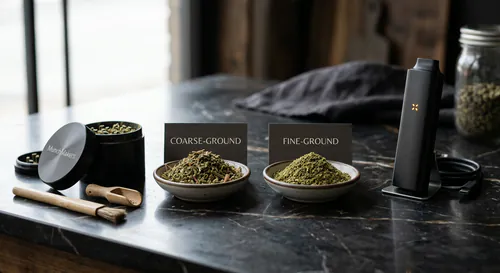
Not all grinders are equally suited for vaporizer use. If you primarily smoke joints or pack bowls, nearly any quality grinder will serve you. But if you use a dry herb vaporizer, the grind you get from your grinder has a direct effect on how well your vaporizer performs. Getting this wrong means uneven heating, poor vapor production, and wasted material.
This guide is specifically about grinding for vaporizers -- what specs matter, how to evaluate them, and what to actually buy.
Why vaporizers need a finer, more consistent grind
A dry herb vaporizer heats material either convectively (hot air flowing through the herb) or conductively (the herb sitting on a heated surface). In both cases, surface area exposure is what determines efficiency. More ground surface on your herb means more even heating and more complete extraction.
A coarse, inconsistent grind creates hot spots. Some pieces get heated and extracted fully while neighboring larger chunks barely get warm. The result is a session where the first pulls are good and later pulls taste like fresh herb because the heat never reached the interior of the larger pieces. You're wasting material.
A fine, consistent grind maximizes surface area uniformly across the whole load. Every piece is roughly the same size. Every piece gets equally exposed to heat. You get better vapor from the first pull through the last.
Compare this to rolling joints, where consistency matters much less. A slightly coarser grind in a joint just burns a bit slower. In a vaporizer, that same coarse grind means genuinely worse performance.
Key grinder specs for vaping
Mesh screen size
On a 4-piece grinder, the mesh screen between the grinding chamber and collection chamber determines what size particles fall through. Most standard grinders use a mesh in the 100 to 150 micron range. For vaping, you want finer -- 80 to 100 micron screens filter out more of the fibrous plant material and let through the finer, trichome-rich powder.
A finer screen means slower collection in the main chamber but finer material overall. Some vaporizer users who grind very finely skip the 4-piece and use a 2-piece specifically to collect everything together, then sieve separately. But for most users, a finer-mesh 4-piece is the better approach.
Tooth count and geometry
For vaping, you want more cuts per rotation. A grinder with 30 to 40 diamond-cut teeth per half produces a finer result per turn than one with 20 peg-style teeth. The cutting geometry matters -- diamond-cut teeth slice through material cleanly rather than tearing it, which produces a more uniform particle size.
This connects to the grinder teeth types guide -- for vaping specifically, diamond teeth are the clear choice.
Chamber depth
A shallower collection chamber keeps ground material closer to the screen, allowing multiple passes through the teeth to break material down further before it falls through. Deep chambers let material escape downward quickly and you end up with a coarser grind. When evaluating a grinder for vaping, shallower grinding chambers with lower drop holes produce finer material.
Electric vs 4-piece for vape prep
Electric grinders produce a very fine, consistent grind with minimal effort. For heavy vaporizer users, an electric herb grinder is worth considering seriously. The grind is finer and more consistent than what most manual grinders produce, and you can grind larger amounts in a few seconds.
The trade-off is that electric grinders give you less control over grind fineness. Manual grinding lets you stop when you've hit the consistency you want. Electric grinding runs until you stop it, and it's easy to over-grind to a dust-like consistency that's actually too fine for some vaporizers -- particularly convection vapes where too-fine material can be pulled through into the mouthpiece.
My recommendation: if you vape daily, the electric grinder is worth having for its consistency and speed. If you vape occasionally, a quality 4-piece manual grinder with a finer mesh screen is sufficient and gives you more control.
Grind consistency testing
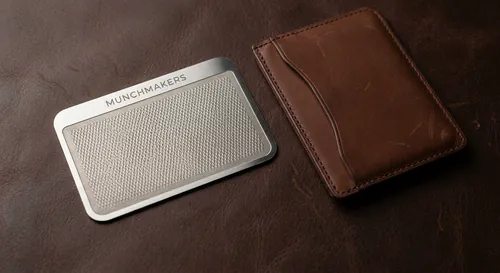
If you're comparing grinders for vaping and want to evaluate grind quality before committing, do this: grind the same amount of dried herb with each grinder using the same number of rotations. Spread the result on a white card and look at particle size distribution. A grinder suited for vaping should produce a relatively uniform spread with minimal large chunks. A grinder optimized for joints or bowls will have more visible variation -- fine powder mixed with larger fragments.
You can also run the result through a standard kitchen sieve to see how much passes through vs stays on top. More material passing through a fine sieve = better grind for vaping.
What to buy
For vaping specifically, I'd prioritize in this order: (1) mesh screen fineness, (2) tooth count and diamond-cut geometry, (3) chamber design. Material matters too -- aluminum is the right choice, not zinc alloy.
The dry herb grinders in our range include options suited to vaping with appropriate screen fineness and tooth geometry. If you're also considering an electric approach, the electric herb grinder is the most direct path to consistent fine grinding.
For a broader comparison of material quality across grinder types, the materials guide covers the full picture. And if you're not sure whether a 2-piece or 4-piece configuration suits your vaping workflow better, the size and configuration guide walks through that decision.
The honest bottom line: a grinder that works fine for rolling will probably underperform for vaping. Grinding for a vaporizer is specific enough that it's worth choosing a grinder with that use case in mind from the start.
If you want to explore compatible vape pens alongside the right grinder for them, that's worth looking at as a combined decision -- the grinder and the vaporizer work as a system, and optimizing both together gives you a meaningfully better experience than optimizing either one alone.