What "510 thread" actually means
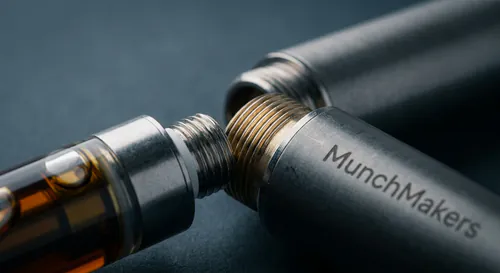
The name comes from the connector specification: 10 threads at 0.5mm pitch. That combination, written as "5/10" and eventually shortened to "510," became the de facto standard threading for vape cartridges and batteries in the early years of the e-cigarette market. By the time cannabis oil cartridges became popular, 510 was already dominant, and the industry adopted it by default.
The practical result is that almost any 510 cartridge works with almost any 510 battery. If you've bought a cannabis oil cart from a dispensary and screwed it onto a battery you already owned, that compatibility is the 510 standard at work. It's not a formal regulatory standard or a branded technology owned by anyone. It's a connector dimension that the industry converged on because it made products interchangeable, which was good for consumers and good for manufacturers who didn't have to engineer proprietary connections.
Not all 510 connections are identical. There are slight variations in the depth and width of the center pin, and some cartridges require more or less adjustment to make good contact with certain batteries. Most problems with "my cart isn't working" in dispensaries come down to this contact issue rather than a dead battery or a bad cartridge. We'll get to troubleshooting that below.
How 510 batteries are different from each other
Once you understand that 510 is just the connection standard, you realize that "510 thread battery" describes a huge range of products that are otherwise quite different. Here's what actually differentiates them.
Voltage is the most important variable. Cartridges have a recommended operating voltage, usually printed in the product description or on the packaging if the manufacturer is helpful. Most cannabis oil cartridges are designed for somewhere between 3.3V and 4.0V. Running a cart at too high a voltage scorches the oil and produces a harsh, unpleasant vapor. Too low and you get thin, unsatisfying draws that never properly vaporize the oil. A battery that operates at a fixed voltage may or may not match what your cartridge needs. Adjustable voltage batteries let you dial in the sweet spot.
Three-setting batteries typically toggle between something like 2.8V, 3.2V, and 3.8V. Variable voltage batteries let you set any voltage within a range, usually via a twist dial or a button sequence. If you're using one type of cart consistently, a three-setting battery is simple and usually sufficient. If you're experimenting with different cartridges or want to tune for different oil viscosities, variable voltage is worth the marginal cost difference.
Capacity is measured in milliamp hours (mAh). A 280mAh battery is small and light but won't outlast a full gram cartridge without a charge. A 650mAh battery can usually get through two or three carts before running out. For everyday use, something in the 350mAh to 500mAh range is a reasonable balance of size and longevity. If you're buying for travel or want to minimize how often you charge, go larger.
Draw activation fires the battery when you inhale. Button activation requires you to click the button before drawing. Draw-activated batteries feel more natural and require no learning curve, which is why they're common on entry-level and disposable products. Button activation gives you more precise control over when the heat element fires, and it's less likely to activate accidentally in your pocket or bag. Experienced users often prefer button activation for this reason.
Form factors available
510 batteries come in a few distinct physical formats, and the right one depends on how you use it.
Slim pen style is the classic: a cylinder roughly the diameter of a thick pen, often around 9 to 11mm. It fits naturally in a pocket and looks like a writing instrument from a distance. Most entry-level 510 batteries are this shape. The tradeoff is that a thinner diameter means less battery capacity and sometimes a smaller internal contact surface, which can cause connection issues with certain carts.
Box mods are wider, flatter devices that hold more battery capacity and usually offer more precise voltage control. They look more like a small box than a pen. Users who take vaping seriously, or who want longer battery life between charges, tend to prefer these. They're less discreet but more functional.
Palm-style or pod-style batteries are wider and shorter than slim pens, designed to fit in the palm. CCELL, a manufacturer whose name has become synonymous with quality ceramic core cartridges, makes a popular palm battery. These tend to have good airflow and reliable contacts, and they're a common choice in the dispensary market.
Concealed batteries are designed to make the cartridge look like a different object entirely. The "lipstick" style is common. These prioritize discretion above everything else and usually sacrifice performance and battery life to do it. If discretion matters, they're a reasonable choice. If performance matters more, look elsewhere.
Choosing a 510 battery: practical questions to ask
What cartridges are you using? If you're buying consistently from the same brand, look up what voltage they recommend and get a battery that can hit that range. If you're buying different carts from different producers, adjustable voltage is a better choice than guessing.
How often do you charge things? If you're already bad about charging your phone, a 280mAh battery will annoy you within a week. Get something with at least 500mAh capacity and a charging method you'll actually use. USB-C is now standard on quality devices. Avoid anything that still uses a proprietary magnetic puck charger unless you have strong feelings about it. Those cables disappear.
Do you carry it in a pocket with other things? If yes, a button-activated battery is worth the slightly higher cost. Draw-activated batteries will occasionally fire in a bag or pocket and waste the cart. Most button-activated batteries require five quick clicks to lock and unlock the device, a sensible safety feature worth using.
Does it need to look good? For a lot of people the answer is yes. A scratched-up plastic vape pen is not a pleasant thing to pull out in public. Metal-bodied batteries, anodized finishes, and clean product design exist at modest price points now. There's no reason to use something that looks bad when good-looking options are readily available in the same price range.
Connectivity problems and how to fix them
The most common issue with 510 setups is a cart that doesn't make proper contact with the battery. The symptoms are weak vapor, no vapor, or intermittent firing.
The center pin on the battery or the cartridge is almost always the cause. The pin on the cartridge should protrude slightly from the bottom of the cart. If it's been pushed in, you can gently pull it back out with a fingernail or the edge of a toothpick. Be careful not to damage it. Some batteries have an adjustable center pin; if yours has one, try raising it slightly.
Airflow is the other thing to check. Some cartridges have small airflow holes at the base that can get blocked by a tight connection with the battery threading. If you screw the cart down fully and it doesn't pull well, back it off a half turn. The connection will still be electrically fine at less than full thread depth, and the airflow will improve.
Threading cross-contamination is rarer but happens. If oil has leaked into the connection area, clean both the battery connection and the base of the cartridge with a cotton swab lightly dampened with isopropyl alcohol. Let it dry before reconnecting.
510 batteries for branded vape products
Dispensaries and cannabis brands that want to put their name on hardware almost always start with 510 batteries because the entry point is lower than building a proprietary format and the compatibility means customers can use their existing carts with a branded battery.
The branding options on 510 batteries are the same as other small metal or plastic hardware: laser engraving works beautifully on metal bodies and is the most durable option, pad printing handles color on plastic bodies, full-color wraps give the most design flexibility. For a deeper look at how the branding process works for custom vape products, see the guide to custom vape pen branding.
Minimum order quantities for branded 510 batteries start around 100 to 200 units depending on the manufacturer and customization method. That's an accessible quantity for a dispensary testing a branded accessory line, and the per-unit cost is manageable. Beyond 500 units, pricing improves meaningfully.
Browse our range of vape pens and 510 thread batteries if you're looking for hardware options to brand.
Traveling with a 510 battery
If you fly, it's worth knowing the rules before you pack. 510 batteries are lithium-ion and fall under lithium battery regulations. The short version: they go in carry-on only, never checked bags. TSA doesn't prohibit them, but you should know that cannabis oil cartridges remain federally illegal, so the question of what's in the cartridge is separate from the hardware rules. For a full rundown of the regulations, the guide to flying with a vape pen covers everything you need to know before you get to the airport.