Why retention is more expensive to ignore than to fix
The average cannabis dispensary customer spends somewhere between $600 and $1,200 per year at their primary dispensary, depending on the market. In states with heavy competition and multiple dispensary options within a few miles of each other, a reasonable churn estimate is 25 to 35 percent annually -- meaning roughly one in three customers who bought from you in 2024 won't be your primary shop in 2025. If you have 1,000 active customers, that's 250 to 350 people finding somewhere else to go each year, each taking several hundred dollars with them.
Acquiring a new dispensary customer costs between $20 and $60 in advertising and promotion, depending on your market and channels. Retaining an existing customer costs a fraction of that. The math on retention is not subtle, and yet most dispensaries put far more of their marketing budget into acquisition than into keeping the customers they already have. This post covers eight strategies that actually move retention numbers, with enough specifics to act on rather than just consider.
1. Tiered loyalty programs that give customers something to reach for
A points-per-dollar program is the baseline, and most dispensaries already have one in some form. The problem is that a flat points program gives customers no particular reason to concentrate their spending at your shop versus splitting it between two or three. Tiered programs create that reason.
A three-tier structure (something like Silver, Gold, Elite) with meaningful tier benefits creates a status dynamic that flat programs can't. When a customer who's at the Gold tier knows that Elite gets them free delivery, priority access to new drops, and a quarterly branded gift, they have a reason to choose you over a competitor even when the competitor is running a better flower deal that week.
The tier thresholds matter. Set them too low and you commoditize the status. Set them too high and customers don't reach them and give up. A reasonable structure for a mid-volume dispensary: Silver at 0 to $499 annual spend, Gold at $500 to $1,499, Elite at $1,500 and above. These are round numbers -- your actual POS data will tell you what percentages of your current customer base would hit each tier, and you want a setup where roughly 15 to 25 percent of customers qualify for a meaningful tier so the program feels achievable.
2. Branded accessories as loyalty rewards that actually get used
Points that redeem for discounts on future purchases are fine. They're also what every competitor offers, and they train customers to optimize for discounts rather than for loyalty. Physical rewards, particularly ones a customer will use and see regularly, do something different.
A custom branded grinder given to a customer at a milestone purchase threshold -- say, their 10th visit or $500 in cumulative spend -- is used multiple times per week and carries your brand through that interaction every time. The cost of a quality branded grinder in the $15 to $25 range is far less than the cost of a percentage discount redemption that erodes margin on a significant sale, and the impression frequency of a daily-use item far exceeds a coupon that gets used once and forgotten.
The product matters here. A cheap grinder that feels flimsy tells customers something about how you value their loyalty. A well-made one does the opposite. Choose products that you'd actually want to receive. Branded promotional products for dispensary loyalty programs work best when the quality justifies the status implication. You're saying "we appreciate you enough to give you something worth keeping."
3. Birthday rewards that feel personal instead of automated
Almost every dispensary loyalty platform sends a birthday email. The question is what it contains. "Happy birthday, here's 15% off your next visit" is a standard redemption offer dressed up with birthday language. It's fine, and it converts reasonably well, but it doesn't feel like anything.
Birthday rewards that stand out are ones that feel deliberate rather than automated. A handwritten or personally signed birthday card (or a message that reads like one rather than a mail merge) combined with a physical birthday gift for high-tier customers -- a pre-loaded loyalty credit for lower-tier customers -- creates a different quality of experience. One dispensary in Denver I know of started including a small branded item in a birthday envelope for their Gold and Elite tiers. The social media posts those customers generated were worth more than the cost of the gift by a significant margin.
4. Re-engagement flows before customers are actually lost
Most dispensaries notice a churned customer after they're gone. The window to prevent churn is while the customer is still in your ecosystem but showing signs of drifting: visit frequency dropping, average order value declining, or a long gap since their last purchase.
A 30-day no-purchase trigger in your CRM (or loyalty platform) can fire a specific re-engagement sequence. Not a generic discount blast, but a message that acknowledges the gap: "We haven't seen you in a while -- here's something for your next visit." Pair that with a specific product recommendation based on their purchase history. Customers who are starting to drift are not the same as customers who have fully left. A timely, relevant touchpoint at 30 days can pull back a meaningful percentage before they fully commit to a competitor.
Sixty-day and 90-day sequences should be progressively more compelling. By 90 days without a purchase, you're in win-back territory and should be willing to spend more on the offer because you're competing against an established habit at another shop.
5. Staff product knowledge as a retention driver
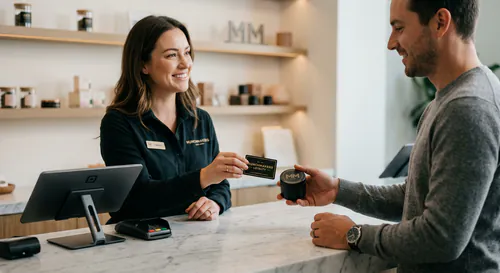
This one is less obvious but well-supported by how cannabis retail actually works. Customers develop loyalty to individual budtenders before they develop loyalty to a dispensary as an institution. When Sarah at the counter remembers that a particular customer prefers indica-dominant hybrids under $40 and can always suggest something good in that range, that customer is not going to a different dispensary -- they're coming back to see Sarah.
Staff training on product knowledge is a retention investment with a direct mechanism. Budtenders who can make confident, personalized recommendations create customers who feel understood rather than processed. The investment in regular product education, including time with brand reps when new products arrive, is cheap relative to the customer lifetime value it protects.
It's also worth tracking which budtenders have the strongest customer loyalty numbers -- if you're measuring repeat visit rates at the transaction level (many POS systems can do this), you'll often see real variation by staff member. That data tells you who to learn from internally and where to focus training.
6. Educational content that positions your dispensary as the expert
Cannabis customers have an enormous amount to learn and often no great source for learning it. A dispensary that publishes a straightforward weekly email with things like "here's how to tell the difference between two cultivars," "here's why terpenes matter for the effect you're trying to get," or "here's how to dose edibles correctly" is providing genuine value that has nothing to do with a sale.
That kind of content positions your dispensary as the knowledgeable source, which makes customers more likely to come to you with questions, more likely to trust your product recommendations, and more likely to regard buying from you as part of a relationship rather than a transaction. Email open rates in cannabis retail average around 20 to 25 percent for promotional emails, but educational content consistently outperforms that in the dispensaries that track it carefully.
7. Exclusive merchandise and early access for top customers
Elite-tier customers, the ones spending $1,500 or more per year, are worth extraordinary treatment because the math demands it. A customer at $2,000 per year with a 10-year dispensary relationship is worth $20,000 in revenue. That's a customer worth a lot of effort to keep.
Early access to new products before they hit the menu for general customers, exclusive branded merchandise that isn't available for general purchase, and invitations to private events or grower tours are all retention tools for this segment. The exclusivity is part of the point -- these customers are being treated as VIPs, and the treatment needs to feel that way, not like a slightly better version of the standard loyalty program.
Some dispensaries have had success with a small branded accessory set (grinder, lighter, rolling tray, all co-branded) that is exclusively for top-tier loyalty members. It functions as a status symbol within the customer community and as a constant brand presence in their daily lives. The production cost for a bundle like this is $40 to $60. The retention value for a $2,000-per-year customer is worth multiples of that.
8. Community events that build something beyond the transaction
Customers who feel like they're part of a community built around your dispensary are substantially harder to lose to price competition than customers who view you as a convenient retail option. Community events -- strain tasting nights, grower Q&As, cooking with cannabis workshops, local art showcases -- create connections that pure transactional loyalty programs can't.
You don't need to run these frequently. Two to four events per year, done well and promoted consistently to your loyalty base, are enough to establish your dispensary as a place and not just a business. The customers who attend these events, even once, have a qualitatively different relationship with your brand. And they talk about it.
Compliance for in-store cannabis events varies by state. Some states permit consumption at licensed retailer events, others don't. Know your rules before planning anything involving consumption on premises. The event strategy works even without on-site consumption -- the social context is the point, not the product use.
Putting it together
You don't have to implement all eight of these at once. The most common mistake is trying to run a comprehensive retention program from the start and executing everything poorly because the operational complexity is too high. Pick two or three based on where you have the most obvious gaps and do those well before adding more.
If your loyalty program is already in place but not tiered, restructuring it is a high-impact first step. If your re-engagement sequences are generic or nonexistent, that's the fastest place to see results because you're working with customers who already know you. If you want to try branded accessories as rewards, start with your top 50 customers and see how they respond before scaling the program.
The dispensaries that have the strongest retention numbers share one characteristic: they treat existing customers as a revenue base worth protecting, not just a pool of people who might buy again. That shift in orientation -- from "how do we get more customers" to "how do we keep the ones we have" -- is what drives the behavioral changes that make these strategies work. MunchMakers can help on the branded merchandise and rewards side of this. The details on how those programs typically get structured are worth a conversation if you're at the point of building out your retention rewards program.