Use code for 10% off your order!

Code copied to clipboard!
Skip to main content
Flavored Rolling Papers Guide

Flavored Rolling Papers Guide

MunchMakers Team

Flavored rolling papers: do they actually taste good or is it all hype?

The honest answer is: some of them taste genuinely good, some taste like artificial candy dissolved in paper, and a few make you wonder if anyone tested them before production. The category has improved a lot in the past decade as demand grew, but quality still varies more than it should, and the marketing often doesn't help you distinguish between them.

Let me explain how flavoring works, what actually tastes decent, and what the health situation is.

How flavoring gets into the paper

There are three main methods, and they produce noticeably different results.

Coated papers have flavoring applied to the outer surface of the rolling paper after manufacture. You can often feel it slightly; the paper has a faint tackiness or smoothness depending on the coating. The flavor tends to be stronger and more upfront because it's concentrated on the surface you're licking and the side facing out. It also tends to fade faster as the paper burns through the coated layer.

Infused papers incorporate flavoring into the paper pulp during manufacturing. The flavor is distributed throughout the material rather than sitting on top. Infused papers generally deliver more consistent flavor from the first draw to the last, and the taste tends to be subtler and more integrated. These are usually the more expensive option within the flavored category.

Tipped papers put the flavoring in the filter tip rather than the paper itself. The smoke passes through the flavored tip and picks up the taste as it does. This keeps the paper itself neutral (so it burns cleanly) while still adding flavor to the smoking experience. Several brands have shifted to this approach because it allows more flavor control without interfering with the paper's burning properties.

Popular flavors and what actually pairs well

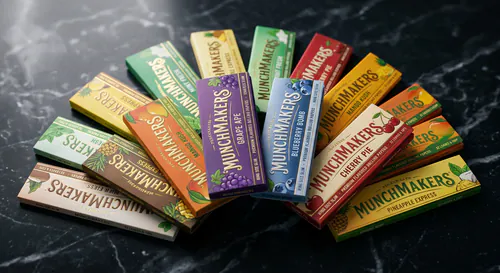
Strawberry is probably the most popular flavored paper flavor worldwide, and when it's done well (natural strawberry extract, moderate intensity) it actually works with most cannabis strains. The brightness of the strawberry cuts through resinous smoke without dominating. When it's done poorly, it tastes like a Starburst wrapper.

Blueberry is a close second and arguably more forgiving in terms of how bad versions taste. Even artificial blueberry flavoring has a mellow quality that doesn't get sharp or acrid at smoking temperature.

Mango and tropical fruit flavors have grown significantly in popularity alongside tropical terpene strain profiles (think fruity sativas). A mango paper with a mango-forward strain is a deliberate pairing that actually works. This is where flavored papers have the most legitimate value: intentional flavor matching rather than just covering the smoke.

Grape and berry tend to read as artificial to most people. The pigments used in deep-colored flavors also tend to add more to the burn profile than lighter flavors. I'd approach these cautiously.

Mint and menthol flavored papers have a dedicated following, particularly among people who smoke tobacco-adjacent products or who find the cooling effect pleasant. The menthol flavor is generally more stable at high temperatures than fruit flavors, which is why it's remained popular despite being somewhat polarizing.

Chocolate and dessert flavors are novel rather than practical. They tend to taste good in the first few draws and then lose the plot as the combustion byproducts accumulate. I wouldn't build a flavor strategy around these, but as a one-off experience they can be entertaining.

Taste intensity

There's a meaningful spectrum from subtle to overwhelming. Subtle flavored papers (most infused, some coated) add a faint aromatic note that complements the smoke without competing with it. These are the better products. Overwhelming papers (cheap coated, high-concentration artificial) taste more like the flavoring than anything else and can make your smoke smell like a candy store in a way that some people love and others find oppressive. Neither is objectively better; it depends on what you're after. But the "does this actually taste good" question usually gets answered by whether the intensity is calibrated well.

Natural vs artificial flavoring

Natural fruit extracts produce more nuanced flavors but cost more to source, which is reflected in price. Juicy Jay's is the dominant brand in artificial flavored papers, and while their flavors are unambiguously artificial, they're consistent and the brand has figured out intensity calibration reasonably well. Blazy Susan produces natural-flavored papers in a premium tier. Cyclones (for pre-rolled cones) uses a range of natural flavors that are generally better than their price point suggests.

If you're making a purchasing decision, "natural flavors" on the packaging is worth something but not everything. The execution matters more than the source.

Health considerations

This is where I'll be direct: flavored papers add combustion byproducts that unflavored papers don't. Every additive, whether natural or artificial, produces something when burned. What those byproducts are depends on the specific flavoring compound and temperature. Most flavored papers on the market have not been formally studied for combustion byproduct safety in the way tobacco products are regulated. This is true of essentially all cannabis accessories in the current regulatory environment.

The practical implication is that if health minimization is your priority, unflavored papers are the better choice. If flavor is what you're optimizing for, natural flavoring applied at moderate concentrations is probably the lower-risk flavor option compared to artificial high-concentration coatings.

Custom flavored rolling papers for dispensaries

For dispensary branding, flavored custom rolling papers are an interesting product category. A custom blueberry or mango paper with a dispensary's logo creates a more memorable consumer experience than a plain paper in branded packaging. The flavor becomes part of the brand identity. Several dispensary groups have used strain-matched paper flavors as a product differentiator. Our custom rolling papers are available in various formats for this kind of branded use.

For comparison, the rolling papers buyer's guide covers the full range of paper types, and the hemp vs rice comparison is useful if you're deciding on the base material alongside flavor considerations.

Share this article:
Written by

MunchMakers Team